Mipam

Lama Yongden
SLG Books
ISBN 0-943389-33-X
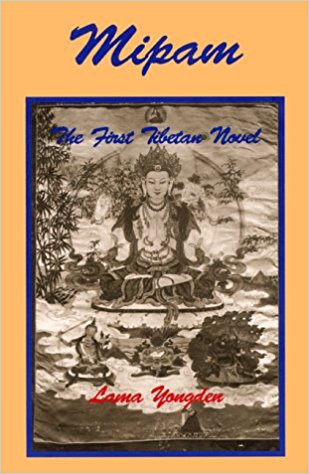
51Y09V1J2NL._SX307_BO1,204,203,200_First published in 1938 this inspired book has been called the ‘First Tibetan Novel’. Mipam is a fictional account of a seeker’s search for love, spirituality, compassion and adventure. Our hero is beset by all kinds of temptations and difficulty before he finally finds his place in the world.

Beautifully written, and illustrated with Tibetan wood block prints, Lama Yongden shares the culture and environment of old Tibet. He draws us into his characters’ struggles between the heart and mind, the spiritual and worldly, their seeking and finding.

Puzzled by this unexpected turn of career in his life from hermit to fiction writer, Lama Yongden notes that:

“Never was the writer’s vocation more unforeseen than in my own case. My life, so it seemed, was destined to be passed, serenely and studiously, in a Tibetan monastery, and had I risen to the rank of a Tibetan writer, my works, in all probability, would have been philosophical treatises, or commentaries on one or other of the numerous doctrines which for centuries past have fed the meditations and the controversies of the learned Lamas of my native land.” 

In a prose similar to his notes, Lama Yongden takes us on a tender and enlightening inner journey that is both moving and compelling. Significant portions of the book feel biographical, which adds to its mystery.

The first chapter begins:

“Portents accompanied his birth. Before dawn, a supernatural light was diffused beneath the lofty trees of the forest on the verge of which rose the rude dwelling of his parents. There alighted upon its thatched roof a pair of birds with golden crests, although it was not the season for their migration. After a long spell of drought, which had sorely tried the thirsty vegetations and the creatures that depended upon it for their food, quite suddenly, although the sun was shining, the earth was gladdened by an abundant shower of rain. A large leopard appeared close to the house, calm, dignified and unafraid, contemplating with attentive eyes the window of the room in which the child was entering the world, and the mother of the new-born babe declared that she had heard, all about her, the songs of invisible beings.” 

This book is a rare treat for aspirants.

 

Books By Swamiji

Happy For No Good Reason

Happy-198x300

A best selling guide to meditation, this book explores the practice and philosophy of meditation including traditional techniques of mantra (the repetition of the phrase) and witness-consciousness (watching the thoughts). You will see how to apply these teachings in every day situations, by developing a moment to moment awareness of the love, joy and peace that unfolds from the center of your being.

The book comes with a CD that, after you read the first two chapters, will have you meditating for the first time within 30 minutes.


Buy online at Ashram Bookstore

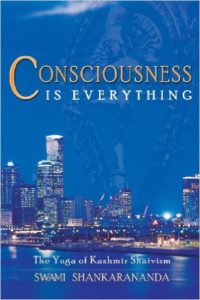
Consciousness Is Everything

Conciousness-200x300Consciousness is the most intimate experience of life, the essence of life itself. Among the many spiritual traditions born and developed in India, one ancient philosophy–Kashmir Shaivism–has explored it completely. Until now, Kashmir Shaivism was an esoteric filed accessible only to a few scholars and other specialists.

Here, for the first time, Swami Shankarananda, a Self-realised spiritual master, presents the wisdom of this powerful tradition in a form that will delight and inspire all spiritual seekers. He explores the teachings in rich detail, elucidating ideas and meditative practices while drawing upon a vast canvas of many great beings, wisdom traditions and personal experience. This is a book that will transform you.

Consciousness Is Everything is a book that will transform you. It is a resource and guide towards investigating and deepening your experience of your own Consciousness.

Buy online at Ashram Bookstore

Self-inquiry: Using your Awareness to unblock your life.

Self-Inquiry-200x300

In this groundbreaking book, meditation master Swami Shankarananda adapts the ancient path of Self-inquiry to contemporary life.

The Shiva Process method of Self-inquiry engages your awareness to effectively remove blocks and enliven the Shakti in the areas of career, relationship, health and spirituality. Building on the teachings of Kashmir Shaivism and Sri Ramana Maharshi, Swamiji provides the tools to reveal  your true nature.

The accompanying CD guides you step by step though a series of inquiries to help you connect with your inner wisdom. You will be transformed and empowered in every aspect of your life.

Buy online at Ashram Bookstore

I Can’t Hear You I Have A Carrot In My Ear

Carrot-200x300

Swamiji responds to questions from seekers about life, spiritual practice and philosophy. It is a guidebook to the inner experience, offering insights and techniques to dissolve ignorance and live with energy and awareness.

Topics include: the Self and Consciousness, meditation, Self-inquiry, mantra, the Guru, Kundalini, Shakti, the mind, relationships, work and career, money, communicating with truth and compassion.


Buy online at Ashram Bookstore.

The Fountain of Grace

The swish of the broom lingers on the edge of my mind as I sit to meditate with Bhagawan. I look up and the temple sweeper, an elderly Indian woman, slightly bent from ageing, casually dusts the carpets in the early morning. One hand is on the broom and one is resting comfortably on her back. I imagine the silent prayers to Bhagawan she speaks as she does her work. Thousands and thousands pairs of feet have walked through this temple seeking Guru’s grace. I am fortunate to be one of them.

Everything is impermanent said the Buddha. There is nothing in the outer world that remains stable, or lasts forever. But here, in Ganeshpuri, the Shakti is the same. Shiva is the same. Bhagawan is the same; Muktananda is the same. That Consciousness never changes. This temple is a refuge, a well from which devotees can sip the deepest waters.

Mandagni Mountain stands as a custodian of the Tansa valley and the village. Mandagni seems ancient. As Kailas is to Shiva, as Arunachala is to Ramana Maharshi, Mandagni is to Guruji. During his years with Baba he saluted its majesty every day.

The valley is mysterious. Legend says that sages did fire ceremonies here and that the Pandava princes stayed here when they were in exile. And even with the smoke from the brick factories, the stench of human excrement, the physical tapasya, the heat and dust it is the most magical place I have ever visited. Discomfort disappears in the presence of Bhagawan whose aura of purity and Shakti sanctifies the valley. The Shakti and peace of the mountain is apparent.

TansaRiver
Tansa River and Valley

A few years ago I was inspired to climb Mandagni when a local swami told me there was a cave two thirds of the way up where Bhagawan meditated. Once a volcano, its cliffs are lava covered and the heat from its former eruptions fuel the hot springs.

Baba once said that celibate cobras with jewels in their foreheads lived there, as well as leopards, meditating yogis and other wild creatures. I saw none of that but the cave is there and it is a cozy nook for meditation. Someone has put a small statue of Bhagawan and built a yagna pit. I could imagine Bhagawan and other yogis meditating there.

One morning Guruji said, ‘we are fortunate to be here in the fountain of grace. For those whose hearts are open to the Guru will experience the love and Shakti of my Guru and my Paramaguru. I am blessed, we are blessed; devotees of the Guru are blessed.’

‘Also,’ he said, ‘any day you can sit under Mandagni Mountain is a good day.’


Death Must Die

51p84xrFRoL._AC_US218_

Death Must Die

A Western Woman’s Life-Long Spiritual Quest in India with Shree Anandamayi MaBased on the Diaries of Atmananda
Ram Alexander
Publisher: First Impression New Delhi
ISBN: 81 86569 32 4

Swami Atmananda never thought her diaries would be read by anyone but herself. A uniquely independent woman for her time, as a young girl maturing in the 40s she was absorbed in Western intellectual and artistic culture. At the first touch of spiritual knowledge she was inspired to explore more deeply her own nature and the nature of reality. Eventually she gave Western comforts up to seek the truth.

Her first spiritual influence was the Theosophical Society, and so she gravitated to Krishnamurti. Dissatisfied still, she was led to the great saint Anandamayi Ma but not without conflict as to whose presence she would take refuge. As a Westerner and a woman, the Brahmin orthodox tested her determination to be accepted as a disciple by Anandamayi Ma.

There is a natural mystery in the drama of her spiritual life, which she takes seriously. Her diaries are frank, honest and sometimes tortured as her spiritual unfolding progresses. She is tormented by the desire for personal love and a personal life, and the longing for liberation, which set up an internal conflict that tears her apart. Doubt is a deadly poison on the path, but ultimately she resolves these two passions and accepts her destiny as a disciple and swami.

On January 23, 1946 she writes:

I am not sincere, my surrender is only a farce. Therefore I cannot concentrate. Nowadays thoughts about the details of how I am going to drop work and what to do with all my things etc. creep into my mind. Then when I think of giving all I have to Her, it occurs to me that suppose I do not get on in the Ashram, what will I do? Suppose She won’t give me money to travel with Her, etc. Is that surrender? But I feel happy to prostrate myself on the ground before her and say: “Take all and make me the smallest particle of yourself.”

Atmananda eventually became a translator for many Westerners who found themselves at Ma Anandamayi’s Ashram. She also edited the writings and books that were published during and after her life. One of the most beautiful excerpts from a conversation Ma had with Swami Premanand was translated by her. Ma advised him:

Meditate on God all the time, whatever you do, wherever you are. Remember that whatever you see, whatever you hear, is He alone. Pain exists because you believe yourself to be separate. Don’t consider anyone as separate from yourself. Regard everyone as your friend…

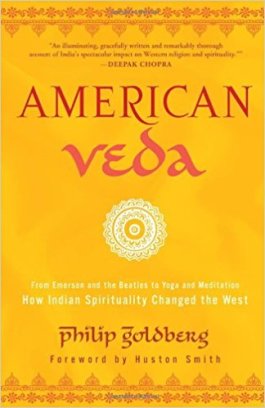
American Veda

This book is by Philip Goldberg, an ordained interfaith minister, and founder of Spiritual Wellness and Healing Associates who has thoroughly researched Hinduism’s impact on North America from the 50s until now.

51Txp+JI-XL._SX322_BO1,204,203,200_


American Veda: From Emerson and the Beatles to Yoga and Meditation
How Indian Spirituality Changed the West
Philip Goldberg
Publisher: Harmony Books, Random House
ISBN: 978 0 385 52134 5

This book fills a unique niche as a commentary on the rise of Vedic teachings, and the Gurus who transmitted them in America. Philip Goldberg is a wonderful writer and spiritual analyst who examined the Vedic exodus from the East to the West, and its considerable influence on American culture.

He writes:

Vedanta-Yoga is a kind of empirical science of the inner life; its postulates can be tested in the laboratory of one’s own consciousness, using the test tubes and Bunsen burners of yogic disciplines. And the goal does not have to be union with God, or Self-realisation; it can be something instrumental, like reduced stress or a clearer mind. In other words, what some saw as theology, others saw as testable hypotheses. What some viewed as spiritual practices, others viewed as therapies.

Even though Goldberg focuses on America, he addresses a dilemma a lot of Westerners face. Buddhists call themselves Buddhists, Christians call themselves Christians, and Jews call themselves Jews. But what do Westerners who have a Guru and have embraced Hindu teachings like yoga and meditation, call themselves? Goldberg made a choice to move away from calling the teachings ‘Hindu’ or ‘Hinduism’ and instead calls the movement by the book’s title ‘American Veda’.

Goldberg eloquently discusses the evolutionary relationship between East and West as a kind of cultural ‘transmission,’ which is seeping into every aspect of American thought and life. He relates stories and anecdotes of the most influential Gurus, practitioners and students of Eastern thought. He traces the spiritual history of Vedic teachings in America, from the first hatha yoga teacher, to the present teachers.

This book is readable, entertaining and immensely interesting. Goldberg is not just a scholar, he is also a practitioner who brings his years of experience and understanding of yoga to the pages.


The Supreme Yoga: Yoga Vasishtha


41rTYjJYHjL._AC_UL160_


Translated by Swami Venkatesananda

Publisher: The Chiltern Yoga Trust (Australia) ISBN 0 9590690 0 3

The Yoga Vasishtha is one of the most noble spiritual works ever written. Translating such an epic work is not easy, but Swami Venkatesananda, a disciple of the late great Swami Shivananda, has done these teachings justice. He is lucid and devotional in his rendition.

The Gurus of this book use the stories of seekers’ lives as a teaching device. Stories cleverly avoid confronting disciples directly. They soften the teachings and the students’ responsibility is to intuit the message the guru is trying to convey. Each story unfolds as a drama of anger, fear, sorrow, vengeance and suffering but also the means to overcome them.

We begin with a question from one sage to another, ‘O Sage, kindly enlighten me on this problem of liberation—which one of the two is conducive to liberation, work or knowledge?’

The sage Agastya replies, ‘Verily birds are able to fly with their two wings: even so both work and knowledge together lead to the supreme goal of liberation.’

Agastya reminds the questioner of an incident where a King refused an invitation to enter heaven. Perplexed by his refusal Indra, the Lord of heaven, sent him to Valmiki, the narrator of most of this wonderful book, for advice.

Thus the story within a story continues when Valmiki, a great renunciant and guru, tells how the sage Vasishtha helped Lord Ram overcome the despair and sorrow inherent in life, to attain liberation.

These are some of the most beautiful yogic teachings available. They communicate the intelligence, energy and love of the Self and inspire meditation.


How To Know God

imgres-1

Translated with a commentary by Swami Prabhavananda and Christopher Isherwood

Vedanta Press  ISBN 0 87481 041 8

I recommend this book for beginning practitioners who want to deepen their understanding of meditation and yoga.


The authors offer us a clear exposition of Patanjali’s Yoga Sutras. There are wonderful anecdotes and metaphors that explain the complex mental gymnastics of yoga.

Yogis often use sleep as an analogy to describe a deep state of meditation and how we come close to the inner Self in sleep. Sutra 1.10 states, ‘Sleep is a wave of thought about nothingness’. The writers explain that the sleep state is actually a ‘positive experience of nothingness’. There is a sense of self, a witness of our experience, even when we sleep for when we awaken we know that we slept.

In my early years of meditation I went into a deep trance state that felt similar to sleep except that when I came out of it I felt a lot of energy. Over time I became more awake in my meditation, more conscious of what was happening in my mind. My meditation went from ‘sleep’ to ‘waking’. True to Patanjali’s sutra, I was aware of what had happened both when I was ‘asleep’ and when I ‘awoke’.

Another striking commentary is Sutra 1.36: ‘Concentration may also be attained by fixing the mind upon the Inner Light, which is beyond sorrow.’

‘The ancient yogis believed that there was an actual centre of spiritual consciousness, call the “lotus of the heart”, situated between the abdomen and the thorax, which could be revealed in deep meditation. They claimed that it had the form of a lotus and that it shone with an inner light. It was said to be “beyond sorrow”, since those who saw it were filled with an extraordinary sense of peace and joy.’

Their writing is inspirational and encouraging. They reassure us that with perseverance we can attain ‘peace and joy.’

Seeking and Finding

I was not looking to worship another;

I was seeking an end to self-hatred.

I was not looking for marriage;

I was seeking a higher purpose.

1250_40491382163_7288_n
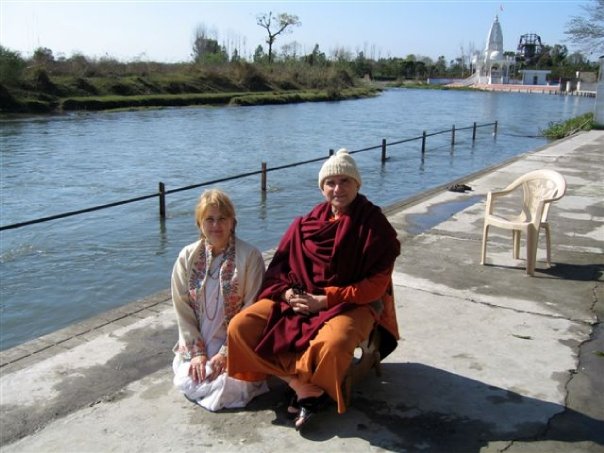
On the Ganges in Kankal 2007.

I was not seeking pleasure;

I was yearning for lasting happiness.

I did not want to be wilful;

I was looking for the one who could hold my heart.

I was not afraid of life;

I was seeking refuge.

I did not want to leave the world;

I was searching for my place in it.

I was not seeking a religion;

I was yearning for God.

Unfold The Inner Shakti

ZenGarden
Zen Garden in the front of the Ashram.

This morning in the shower I picked up a little wood bug that was struggling on its back to roll over. Many small creatures find their way into my bathroom and I try to save them. I don’t like to see them or anything suffer. When given a choice to kill defenceless creatures or save them, I will try to save them even if some are resistant.

I fed the dogs, sat down and looked out over my courtyard. As I glanced around I realised there are many thriving plants I had saved from death’s door. ‘What is this’, I asked myself. Do I have some kind of saviour complex? If I do it is not like Mother Teresa. I would never go to Calcutta and pick up lepers off the street. I might imagine doing it. That is not my purpose or way of serving but I am grateful to those who do it.

I love to watch people, animals, flowers grow and flourish. To grow inwardly and outwardly is to expand the Shakti. I hate to see things wither and dry up. The garden in the Ashram was a wasteland when we bought it. I have taken great pleasure, along with a whole team of people, turning it into a place of beauty and peace.

This morning a plumber came to quote on a job. ‘What is this place?’ he asked Bhaktananda. ‘It is so beautiful.’

Much more than destroying things, I love to build things and watch them being built. There was a time when the opposite was true. I was filled with self-hatred, doubt and fear, but the Guru changed my vision of myself and the world. Free of self-concern by Guru’s grace, it is possible to make a contribution that feeds my soul.

Over the years many young people have come through the Ashram doors, confused, agitated, broken-hearted, drug or alcohol addicted, lost and without purpose. After some years most have transformed and found their purpose, their life partner, and their career. To provide an atmosphere where seekers can awaken to Guru’s grace and unfold their destiny is the most sublime work.

When students move out of the Ashram to begin their householder lives, Guruji calls it ‘Graduation’ and gives diplomas based on the number of years they have spent in the ‘Ashram Residential Course’. When once the world reflected their negative mind states, now it reflects their growth and essence.

In the beginning of Guruji’s book ‘Consciousness Is Everything’ he quotes from the sage Keshemaraja on how to dispel suffering:

He is a bound soul who has poverty of Shakti. With the unfoldment of his Shakti, however, he becomes Shiva himself.

To unfold the inner Shakti and become Shiva means freedom from pain.

Shaivism says that Shakti unfolds with the grace of a Shaktipat Guru. And so many ashramites have moved from darkness to light, from ignorance to understanding during their sadhana with Guruji. Confusion has become clarity, addiction a passion for God, heartache love of Self, and aimless wandering a sense of purpose.

With the Shakti we will never feel impoverished, never feel a lack, never feel alone, never feel lost, never feel confused and never feel separate.

The other night in study group Guruji said, ‘It is rare to meet a Sadguru. Once you have met the Guru you can find a million reasons to leave him. But, there is only one reason to stay…and that is to know the Self.’

The connection with the Guru’s Shakti nourishes our whole being and unites us with his state of Consciousness. It is a direct line to Shiva, who breathes life into us and sustains grace.

When that connection wobbles we suffer from ‘poverty of Shakti’. The highest priority, whether you are an ashramite or a householder, is to maintain the flow of energy. When we hold to that we discover a love that weathers all storms.

Take Refuge In A Siddha

Ganeshpuri February 2017

Our Ganeshpuri Retreat is in full swing. This tiny village is a source, a wellspring of Shakti, a doorway to higher Consciousness.

A few days ago we had a Guru puja, the beginning of a process of initiation into the siddha lineage for seven worthy seekers who are devoted to the teachings, sadhana and the Guru’s work. All of the initiates have said they feel a calling to serve the Guru.

Ganapati Levine and Renuka, took sannyas; Vani and Janaka Stanford took a Shiva/Shakti initiation. Gargi and Ramana took a Lineage initiation. LeRoi Zavier, from California (in absentia) was also included. As part of the ceremony they received new names. Ganapati is Swami Ganeshananda, Renuka is Swami Paramananda, Vani is Yogini Sri Vani Ma, Janaka is now Yogi Sri Janaka, Gargi is Sri Gargi Saraswati and Ramana is Sri Ramana Saraswati. LaRoi is now Swami Sahajananda.

Guruji said that the greatest initiation is Shaktipat from a siddha guru. ‘No one should feel jealous of the initiates. Their initiation belongs to all of us. We share in their process. We are fortunate to be a part of this great path, the great power of the Kundalini Shakti and to be connected to Bhagawan Nityananda and Baba Muktananda. If you are jealous maybe it means you need to take a step like this.’

In the morning Santosh, the Brahmin priest from Vajreshwari led us through the puja with his usual skill saying that it is a great honor to be connected to the lineage and serve the Guru. To do Baba’s work is a calling from the siddhas. Guruji later said that God looks for hearts that are open so they can do His work.

That afternoon Guruji spoke about sadhana and pledging ourselves to the path. He said that when he took sannyas he was overwhelmed by love and gratitude that he was taken into something greater than his individuality, that he was absorbed in the great ocean of divinity.

Quoting from a talk Baba gave in 1981 before returning to India Guruji said that Baba encouraged everyone to ‘remember the Self, remember the mantra, take refuge in the Guru and the Satsang’:

As long as you don’t have the knowledge of the Self this appears as a mere world. But once you have knowledge of the Self, this is no longer a mere world; it is the play of Consciousness. This is the path of equality. Understand that whenever you oppose somebody you are actually opposing yourself. Everyone is the child of the Lord.

When everything is Consciousness, how can you say, “this is high, and that is low? How can you say, this is good and that is bad? What person can you reject saying he is bad? What person can you accept saying he is good? When everything is one, everything is your own Self.

This world originated from siddhas. Whoever follows the siddha path can become a siddha. If you have the awareness of oneness, seeing God in each other, you won’t have emotions like hatred, anger, enmity, jealousy or envy. Hold the awareness siddha sharanam gachchhaami—I take refuge in a siddha. Only when you take complete refuge in your Guru can you draw the Shakti, the power of the lineage of siddhas.’

In the early morning Guruji completed the sannyas and initiation ceremony. The swamis went symbolically to the river and renounced the three worlds, the attachments that bind them to the material plane. They then walked north towards the Himalayas. Guruji called them back and asked them to serve humanity. They agreed.

All the initiates gathered on the verandah and we watched as Guruji covered his head and theirs with a silk shawl Baba had used in a sannyas ceremony in Gurudev Siddha Peeth which he later gave to Guruji. Guruji whispered a mantra and a new name to each initiate.

There was a feeling of stillness in the atmosphere, a sudden quiet as though Ganeshpuri itself was honoring this moment.