Baba’s Vows

02r

Baba gave these aphorisms at an unexpected Satsang in South Fallsburg just before he left for India in 1981. At the end of his talk he asked us to repeat them aloud.

As destiny would have it they now seem like his last instructions on how to remember and stay in touch with the Shakti and the Guru.


siddham sharanam gacchaami

I take refuge in a Siddha.

sangham sharanam gacchaami

I take refuge in the community of Siddhas.

svaatmanam sharanam gacchaami

I take refuge in my own Self. I surrender myself to my own Self.

svaatmachintanam na jahaami

I will not give up the contemplation of my Self.

siddhamcharanam na tyajaami

I will not abandon the discipline of the Siddhas.

svamantram na vismaraami

I will not forget my own mantra.

bhaavam satatam bhajaami

I will always maintain the awareness of the unity
of Brahman and the Self.

sarvam shivamayam pashyaami

I will see everything as Shiva. I will never think that anybody or anything is different from Shiva.

In every situation, we either burn through karma or we transcend it.

Alone With Bhagavan

421575_10150712280667164_734907163_9195921_1224671515_n
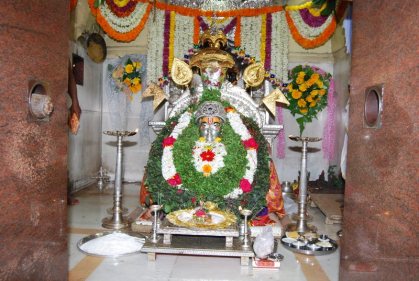
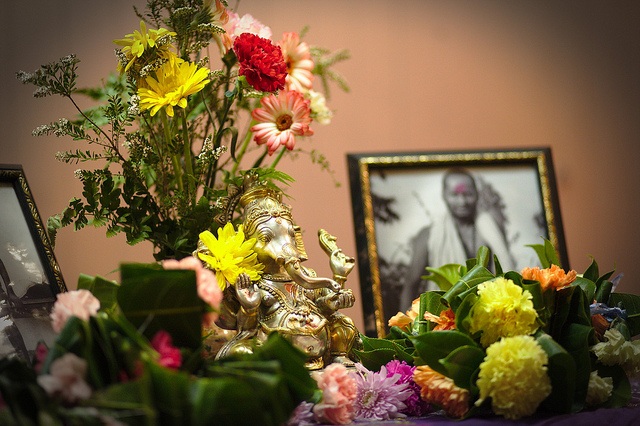
Bhagavan’s samadi, Ganeshpuri, India

When I feel overwhelmed by work I often imagine myself sitting by a river with nothing to do but meditate, alone. The river Tansa is nearby and I realize I have been given a cherished wish.

I wake up early and meditate outside on the veranda. The mornings are cool and I rug up in shawls. Sounds of creatures waking are abuzz: Arati bells ringing, crows cawing, roosters crowing, hens clucking, kites screeching and woodpeckers pecking. Sudarshan the new cook at Kothavala, who lost his parents when he was young, has adopted Guruji and I as his spiritual mother and father. He chants mantras as he brings chai and biscuits. I breathe in the atmosphere. This is where I want to be.

At 7:00AM I head for Kailas and meditate in one of Bhagawan’s many bedrooms, which is only open in the morning. I take darshan of his funky chair and head for the temple. Shop owners are quiet, not yet hawking their wares. The chai stalls are opening but each has their own takers. The same faces are there every morning. The rest of the day my routine includes chatting with people, Arati, lunch, rest, writing, dinner, hot baths, arati at the temple and sleep. Many villagers are surprised I am here alone and wonder if I am okay. I find myself getting to know some more intimately. I like this inner movement of friendship. I relax into the tempo and find the days pass quickly.

2013-11-29 09.29.58
Mt Mandagni, Ganeshpuri

Bhagavan’s Samadhi shrine is my favorite place to meditate during the day even though there are more comfortable and quiet spots. There is no logic to my preference. Devotees are chattering, children are running freely, bells are clanging, flower girls are shrieking, devotees are praying and priests are chanting. The outer world is busy, chaotic even, but inwardly I am blissful. Activity here arises from the highest Consciousness, undisturbed by disturbance. I imagine this is what it would have been like to be in his physical presence.

My sister is having some health problems and I decide to do a Guru Paduka puja (ceremony for the Guru’s sandals) for her in the Temple. I am concerned that I might be faced with a non-English speaking priest and decide to invite Indu, a village elder who spent much time with Bhagawan to join me. She speaks enough English to get me through the awkwardness of not understanding Hindi and the uneasiness of doing something wrong.

Indu, the priest and I will bathe Bhagawan’s sandals in milk and water from the natural hot springs, and then mark them with sandalwood paste, kum kum, tulsi leaves, ash, perfumed oil and flowers while mantras are chanted.

Indu’s company is calming. I find it humorous that my confidence wavers in the presence of the Brahmin priest Devidas. Guruji has nicknamed him Freddie Mercury, the lead singer of Queen, because he is tall, slim, and charismatic.  His devotional style, when waving the lights during Arati to Bhagavan, is flamboyantly artful and full of devotion. But here now, the language barrier inhibits my ability to connect with him. I cannot ask questions or chat.

Devidas begins by telling me that this day is a most auspicious day, more so than any other day I could have chosen. It is moksha ekadashi, the 11 day of the month of the waxing moon. To do a ceremony today means auspicious blessings, spiritual liberation, for my family and me. The puja is beautiful even though I inadvertently pour the hot water meant for Bhagavan’s sandals all over his lap. ‘Slow, slow’ he says.

As Devidas chants the mantras I embrace Bhagawan’s Shakti and give myself up to the power of this incredible Siddha’s grace. I tune in and the Temple sounds become a distant aum as I open to the moment. The murti in front of me is shimmering with Chiti. I am awed by the power of Shiva’s light.

The other side of Shiva, the dark, is never far away in India. That night I awaken to a puppy shrieking in pain. I vow to pack them up and smuggle them back to Australia. Or, I am going to start feeding them. Neither is possible. I tell myself that next time I am bringing a vet. Most dogs are uncared for and live on sugar treats thrown to them by pilgrims leaving the temples or scraps from the chai shops. Diabetes is not just for humans. Of course they procreate continually. Neuter a dog—it is unthinkable even for the educated.

At night there is the howling of animals being born and dying. How is it that the pleas for food and shelter can be ignored day after day? I could not live here without doing something about it. Guruji often jokes that it is good karma to be born a dog in the West and a cow in India, and bad karma to be born a dog in India and a cow in the West.

One Westerner, an American woman, has been living here for over 20 years. She feeds and tends numerous dogs and cats every day even though her finances are stretched. She is quite elderly, fragile and worries about who will take care of them when she is gone.

Everyone needs something. From a young man in a wheelchair, whose home is unsuitable, to another with five children under the age of eight whose house was washed away in the monsoon and now lives in a leaking tin roof hut—no plumbing of course. There is also a young man needing sinus surgery and a young girl who recently lost her mother and stays with her older sister. There are lots of children and most in need of some sort of medical attention. I cannot forget the line of beggars, who are fed by the Temple every day, but whose desire for human attention calls out to every passer by.

Then there is the problem of alcohol. Made locally it destroys the eyesight of devotees who worship at the palm shrine. Alcoholism is on the rise and there is no AA here. So too is drug addiction and HIV.  Garbage and sewage sprawl across roads and pathways. The stench is a constant. One person I meet suggests that India’s biggest mistake was to get rid of the British. By now, he says, they would have an infrastructure; sewage and garbage would be handled. And, there would not be a Pakistan.

My mind spins: I could do this; I could do that. I can get this; I can get that. But I know I can do little or nothing. I accept it all as it is, yet feel the anguish. I look away but I am not indifferent. I give myself permission to feel the pain of existential angst without despair. I have learned I can only help when God allows.

This is India. It can drive a weak mind mad. Heartless on the one hand with death barking at your heels every moment and yet full of the wonder of worship of God. My thoughts turn to home and contemplate how to hold onto this particular experience of the Shakti.

In the early morning I sit on the porch and watch the sun rise. The village is still in the early hours. Soft noises of awakening do not disturb my meditation. I wait for chai and biscuits in awe of the blessings that flow from Bhagawan Nityananda. I am in the mind of Shiva, dark and light emanating from his mystical heart. Mother India clasped me to her breast and fed me her soul. I don’t believe there is another place on the planet quite like this. This is home.


Your First Meditation

Excerpt from Chapter 2, Happy For No Good Reason by Swami Shankarananda

magnaha svachittena pravishet

Meditation is achieved by diving into the

deeper levels of the mind. (Shiva Sutras III.21)

TAKING ADVANTAGE OF modern technology you can immediately begin to meditate. The value you receive from these teachings will depend, most of all, upon your commitment to a daily practice of meditation. I suggest you sit down and listen to the Chakra Meditation, the first two tracks, after reading this short chapter.

The first track is just under eight minutes long. I use this technique in all my meditation courses. It helps you become aware of inner tension. In this meditation you investigate the thoughts and feelings in four of the seven chakras: the navel, the heart, the throat and the brow. I ask questions like: “Is the feeling pleasant or unpleasant, tense or relaxed?” This gives you an awareness of the tensions and blocks you may be carrying and also puts you in touch with expanded and uplifting feelings.The second part is the Healing Meditation . Here relaxation and wellbeing are emphasized. You return to the four chakras with a view towards acceptance,love and peace. Follow my narration using its statements and images to release the tension. Experiment with each idea and image. At the end you can find the best feeling and focus on it for the rest of the meditation.

ESTABLISHING YOUR PRACTICE: WHERE AND WHEN

The traditional time for meditation is early morning. Your mind is calm,the phone is not ringing and the children are asleep. Another good time to meditate is at night before you go to bed or early evening just after you have come home from work. Experiment and see what works for you.A proper meditation posture helps the energy of meditation flow throughout the body. Zen meditation quite rightly describes two ways not to meditate. The first is called Kontin,  the posture is too “mushy,” too loose—the chin falls, the back bends. The second, sanran , is the opposite. The meditator manifests too much rigidity and tension in the body. One is too easy-going and surrendered,the other too tight and self-willed.You can sit in a comfortable easy chair or on a cushion on the floor. Your posture should be relaxed and comfortable but also alert. It is best to sit with your back straight and hold your head erect but without tension. It is all right if your head falls forward or backward after you have been meditating for a while.Wear comfortable clothes. You may want to keep a blanket or a favourite sweater handy in case your temperature drops. You may feel cool one moment and warm the next.

med4
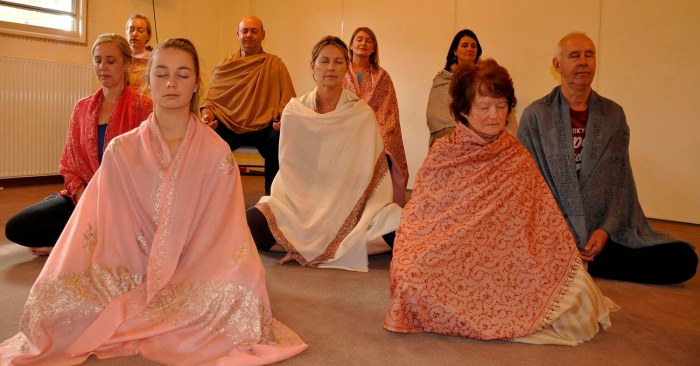
Everyone can meditate. Sit on the floor or sit in a comfortable chair.

Hatha Yoga has become very popular in the West and is practised to prepare the body to sit for meditation. The postures increase flexibility,strengthen the spine and release tension. Hatha Yoga works on every aspect of the body, including the organs. It is physical culture for the 21st Century. Good health and suppleness are by-products. I suggest you find a good teacher in your area and learn the postures. It will help you meditate effectively.

Where possible set aside a room or a niche for meditation. When you meditate in the same place every day, the meditation energy builds. You can create an energy-filled space by placing pictures of great beings or symbols of higher Consciousness around the area—whatever objects or music you find conducive for entering meditation. You might want to burn some essential oils or incense. This creates a positive atmosphere.

I knew a woman whose husband was violently opposed to meditation. If her meditation paraphernalia was visible it caused turmoil in the house. She cleaned out her closet and created a meditation “cave”. She put her meditation pillow in there and had a tape of the mantra playing constantly. She would tell her family: “I am going to my cave to meditate.” She was, in every sense of the word, a closet meditator.

Meditation is the single most important discovery I have ever made.Without doubt it has transformed my experience of life. It gives me great joy to welcome you to the practice.

YOUR FIRST MEDITATION

Now is a good time to sit down and become familiar with the Chakra Meditation. Close your eyes, turn within and follow the instructions on the CD or do the written meditation in the appendix. Meditate to the first two tracks.

Chakra Meditation

KEY IDEAS OF CHAPTER TWO: YOUR FIRST MEDITATION

  • The traditional time for meditation is early morning.
  • Proper posture helps the energy flow.
  • Sit comfortably. Keep your back straight but relaxed. Do not become rigid.
  • Hatha Yoga helps prepare the body to sit for meditation.
  • You can create an energy-filled meditation space.
  • Meditating in the same place every day builds the energy.
  • Use your CD or your Chakra Meditation every day for at least half
  • an hour.
  • Even if you have the CD it is useful to read through the written form in the appendix one time.

Online Learn To Meditate Course with Swamiji

  • Learn to Meditate Course (Online)

    Online Course available on demand.

    $95

WATCH ONLINE

Using your Awareness to unblock your life

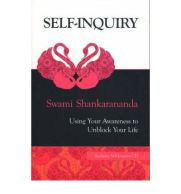
Excerpt from Self-inquiry: Using your Awareness to unblock your life by Swami Shankarananda

AS A SPIRITUAL teacher, I meet many people. I hear sad stories. I’ve come to the conclusion that the task of being a human being is a difficult one.

When the soul takes on a body, it becomes confused. The physical plane is indeed hard to master. People don’t know how to conduct their relationships. They don’t know what to say and when to say it. They don’t know how to earn a living nor how to save their money. They don’t know how to deal with their desires and fears nor how to discipline the energies of their body.

When we are born, we are not given a how-to manual, and the advice we get from our family and culture may be remarkably wrongheaded. Nonetheless, there is an appropriate art of living. The great masters have called this art many things: living in the Tao, Zen, yoga, Tantra, the natural state (sahaja samadhi). These names given by different traditions refer to the same thing: a life lived from the centre outward, a life in contact with the Self. Because we are blocked in career and relationship, in the areas of health and wellbeing, we need a method to cut away the misinformation under which we struggle, and get to the truth. Self-inquiry is that method. Self-inquiry gives us a way to deconstruct the false co9780975099537nstructions of the mind, and reveal the true Self.

Self-inquiry is the mother of all spiritual methods and all forms of meditation. It is direct, sleek and effective. It requires no religious belief, nor any dogma to practise it. It is very much in the modern spirit because, like science, it is a quest to discover what is. The need for inquiry becomes critical when we understand that we are broadcasting stations for our feelings. We live life passionately and we always speak and act out of one feeling or another. If we have a negative feeling, like tension, anger, fear or depression, we express that feeling through negative thoughts, negative actions and negative speech. We blame others. Our thoughts, words and deeds express our negativity.

This has a profound impact on our life. If we are broadcasting negativity, other people feel it. We don’t get the job we have interviewed for. People move away from us. They avoid our company. Even our pets run away. We may blame circumstances and other people, but the source is in the thoughts and feelings that we are broadcasting through our speech and our actions. As intelligent yogis, we become aware of our negativity, whether by direct instruction or the feedback we are getting from others. Instead of projecting the feeling, we take it inside through Self-inquiry and seek to purify it. We investigate the feeling, release it, relax it and take responsibility for it. After successful inquiry, our feeling is now positive. We radiate joy, love, peace and confidence, which translate into positive thoughts, positive actions and positive speech. Now we get the job we seek and people want to be around us. Our life is positively transformed by means of Self-inquiry.
(Try listening to the below meditation Speaking to your mind.)

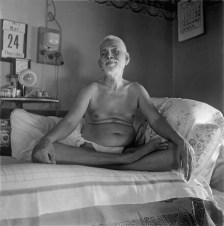
Sri Ramana Maharshi

ramana
Sri Ramana Maharshi


The name most linked to Self-inquiry in the history of spirituality is that of the great 20th-century Indian sage, Sri Ramana Maharshi. Ramana said that all methods must necessarily end in inquiry. His reasoning was something like this: you meditate on an image of the deity or the Guru, or you contemplate a spiritual principle, or even look at a yantra (sacred diagram). In the end, the question will arise, ‘Who is it that is seeing, hearing or experiencing whatever you are meditating on?’ And with that question, inquiry begins. The attention moves from the object to the witnessing subject; from the periphery to the centre. Self-inquiry is an inner investigation that moves to the core of reality—ever more inward, more real, more true, more present, more vibrant, more central is its direction and thrust.

I met my Guru, Swami Muktananda (Baba), in Delhi early in 1971. There was a big tent on a sprawling lawn and hundreds of people were attending satsang, a spiritual gathering in the company of a great being. In the corner, a young man was sitting in meditation but he was also vibrating, hyperventilating and flopping about like a fish. I’d already heard that Swami Muktananda had a legendary power to awaken the kundalini energy, the inner divine power of seekers, and this caused kriyas, yogic movements, that were sometimes quite physical or even violent. This was the first one I’d ever seen and I looked at it with a sceptical eye. But it passed the test: I knew it was genuine. Some force other than his own will was moving in that young man. At the same time, an inner knowing arose in me: ‘That will not happen to me!’

I was correct in that while I had many spiritual experiences, I never did flop about like a fish. But shaktipat, awakening of the kundalini energy by the Guru, can manifest in a wide variety of ways. Because of my scepticism, when the energy started coursing through my body forcefully, my first thought was that I might have malaria! Finally I noticed that my ‘malaria’ was strangely responsive to the evening Arati program. I realised I was experiencing an awakening.

In my case, the most significant effect of shaktipat was that it drove my mind inward and gave birth to the process of inquiry that has become the Shiva Process. My mind had been exceedingly external; only divine grace could reorient it inwardly. Feeling frustrated with my efforts to know the Self, I asked Baba for advice. He told me that rather than straining to know the Self conceived of as far away, I should know that the Self is always complete and perfect within me. He said I should contemplate ‘I am the Self. I am Shiva’. By Shiva, he was not referring to the Hindu deity of that name, but to universal Consciousness, the substance of the Self. His answer transformed my sadhana by 180 degrees. I no longer felt I was striving for some attainment, but rather that the attainment was already present and I had to rediscover it.

According to one yogi, there are two significant obstructions to knowing the Self. One is ignorance of its existence and of the possibility of making contact with it. The other is a tight, cramped state of inner tension. Baba’s answer had solved the first, though the latter remained a problem.

On another occasion, I was meditating in the company of my teacher. Feeling on that day the contraction of my being, and frustrated by how far away the goal seemed, I strained to go deeper and have a more profound experience. I felt blocked and discouraged. Suddenly, the understanding arose in me, ‘You may not be having the meditation you want, but you can always have the meditation you’re having’. With it came an intuitive grasp of a completely different spiritual orientation. I would no longer seek something I felt I needed or wanted, but I would now investigate what actually existed. Combining this with Baba’s instruction that I should contemplate ‘I am the Self’, I had the beginnings of a complete method. Following it, I focus on my inner world, arming myself with his instruction that the Self is already here, already present, though perhaps hidden. I decide to investigate my experience in the very moment. Exploring inwardly, I discover a rich variety of phenomena: movements of energy, subtle feelings and sensations.

With my inner eye, I see a number of lights. Most interestingly, I discover blocks and areas of tension in my subtle world. These attract my attention. I can see directly that they affect my wellbeing and my emotional state. The energy of my inner world does not flow properly and harmoniously as long as these tensions remain. I intuit that these blocks, which are more subtle than physical, can eventually manifest as disease. Acknowledging that these tensions have a profound effect on me as well as on my spiritual state, I feel I’ve come face to face with my spiritual dilemma as it shows up in the moment. I begin to investigate these perceived blocks. What are they made of? What causes them? I try to get as close to them experientially as I can. I inquire into them and they yield information. My inner voice tells me, ‘This is anger. This is fear’. I inquire further. A knowing arises that these tensions are connected to a circumstance that happened today, or a week ago, or even years before. I am starting to unravel the mystery of my inner being.

Sometimes a solution to a block arises in my awareness spontaneously, and when that happens, the block dissolves and I feel a release of tension. My inner being is more harmoniously poised. I leave this meditation in a far more uplifted state than I began it.

I had hit on a method that seemed a universal way of dealing with spiritual obstacles. Where Ramana’s inquiry focused only on Self-knowledge,the inquiry I was doing was applicable to all areas of life. I discovered that the problems I encountered with other people, issues of work in the ashram, doubts that arose in my sadhana, all showed up within me as tensions and blocks. I could work within myself to release these blocks by finding intuitive means. Having worked on them within, I noticed that obstacles were simultaneously removed from my outer life. My inquiry took wings in the presence of my Guru, and I felt certain that his spiritual energy, his Shakti, brought my inquiry to a boil.

The philosophy of Kashmir Shaivism says that this whole universe is an unfoldment of Consciousness. At the very interior of the universe is divinity, pure light, pure energy and pure love. As Consciousness unfolds externally, things become more gross and material. When we investigate anything, we go in the opposite direction—from the outer to the inner, from the husk to the kernel, from the external to the essence. In a world of Consciousness, everything is subject to inquiry. When we have a conversation, there are the words that we speak and their meaning, and then deeper down, a more real conversation occurs at the emotional level. The universe is a detective story and becomes, as we move from the periphery to the centre, always more real.

Sannyas

3315_1139690086046_3417375_n
Ganeshpuri 2009 Sannyas ceremony

I left my heart at my Guru’s feet. There is no taking it back once given. My fate sealed my destiny decided. I am his. This is the only truth I know. What is done cannot be undone. What is to be will be. How easy to love in the light of the sun. How difficult to love in the shade of darkness. My prayer is that we all flourish in the radiance of guru’s grace.


In 2009 Swamiji asked me if I wanted to take sannyas, to become a swami (monk), in our tradition. This initiation would formally acknowledge my dedication to yoga and meditation, and my commitment to ashram life and to serving others. There have always been mendicants, seekers who devote their lives to spiritual practice and whose goal is Self-realisation.

This tradition was formalised by the great Adi Shankara, who traveled around India teaching from 788CE to 820CE. Shankaracharya, as he became known, was the founder of Advaita Vedanta, a non-dual path of wisdom. He established four maths, or ashrams that still operate today; much later a fifth was established. His initiates were called sannyasis.

Sannyas was closed to women and also to foreigners until the last century. In the 70s Anandamayi Ma, Bhagawan Rajneesh (Osho), Swami Muktananda, the Ramakrishna Mission, Swami Satchidananda and a few others gave sannyas to Westerners. However the initiates were usually associated with, or taken care of by an ashram or their Guru.

The ceremony is likened to a funeral service. It is a ritual designed to dissolve worldly desires, unhealthy attachments to the body, to possessions and personal relationships. Metaphorically the initiate dies to their previous life and is reborn into a life of service, teaching and study.

Brahmin priests trained in the ancient practice of chanting Sanskrit mantras perform the pre-sannyas rituals. These mantras carry a purifying energy that works on the subtle and physical body. There are mantras to purify the five sheaths; mantras to shed past karmas; mantras to become a Brahmin; and mantras to protect the mind. There are mantras to break attachment to family, friends and loved ones; mantras to cut away attachment to the body and sensual pleasures; mantras to prepare for the final initiation, which the sannyas Guru performs, in this case, Swamiji.

This was not the first time sannyas became a possibility for me. In 1982, just before his death, Baba Muktananda gave me the opportunity to become a swami. At that time I was struggling in my sadhana. Swamiji was in Australia, my husband had become a swami and I felt at loose ends and uncertain as to what I truly wanted. However, I was afraid of my will and desire, and my impulsive nature. I was not sure that I was finished with worldly life. I felt unready to commit to the renunciation that I imagined sannyas to be. And so I did not accept.

Now, becoming a Swami did not seem like I would be taking an uncomfortable step into the unknown. Whatever held me back in the 80s was no longer present. However, as the ceremony approached I was aware that I had some apprehension and uncertainty. I questioned myself. Was it suited to my temperament? Were the tendencies of my mind antithetical to sannyas?

I can be volatile, passionate and head strong, and need a certain amount of physical comfort. I have spent many years working on understanding my emotions and how they cause me suffering. I used to bristle at being told what to do, how to do something and when to do it. I was not sure these tendencies had been put to rest enough and would not again rise in my consciousness. I intuited that the ceremony might intensify the demand on me to be more disciplined both in my spiritual practice and my mental habits. There was no pressure on me except my own inner process. And so, in January when we went to India for five weeks with a number of people on a spiritual pilgrimage, sannyas was on my mind.

The ceremony would be held in Ganeshpuri, near the heart of my path which I hold so dearly. Going through an initiation there appealed to my romantic spiritual inclination. I love India, especially the little dusty village of Ganeshpuri, from which the great Siddha, Bhagavan Nityananda and his disciple, Baba Muktananda, gave Shaktipat, kundalini awakening, to thousands of seekers. It is also where Swamiji did his sadhana.

In 1978 when I first stepped through the gates of Gurudev Siddha Peeth, I felt swept back in time to a place where there was no ignorance or suffering. I remember the profound feeling of belonging. In the radiance of Baba’s Shakti I easily connected to my essence. There was something so sweetly tender and intensely powerful in the atmosphere. How those two arose simultaneously is still a mystery.

And so the night before the ceremony I was remembering my early days of sadhana. As I contemplated what was before me my attitude shifted. I meditated and realized that I wanted to become a swami; that I wanted to accept the yearning of my heart to reach for the Highest.

Four other disciples of Swamiji: Jani Baker of Classical Yoga, Kali Noelle, head of our Hatha Yoga department; Dylan Frusher, Bhaktananda (who took sannyas here a few years ago, but who asked to go through the ceremony with us) and Rama Berch, the head of Master Yoga Foundation (Svaroopa Yoga) in America and one of the founders of Yoga Alliance (America) would also take it.

Swamiji directed the ceremony, with eight Brahmin priests. His presence was a soothing balm to the fire of the mantras. As the Brahmins chanted the opening mantras I began to leak from every orifice—my nose was running, my eyes were watering, and I was perspiring in every part of my body. I also had an uncontrollable urge to run to the toilet. At an appropriate time I shyly asked the Brahmins to be excused.

22354_222171004773_7500803_n
After taking our vows.

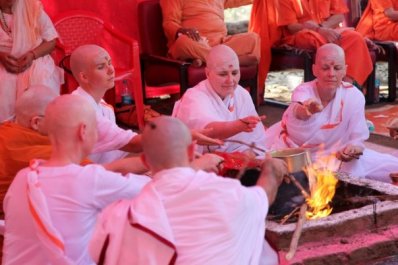
We were dressed in white clothes that we would throw in the river after the ceremony.  Our heads were shaved–apparently there is a lot of ego in hair. I was looking forward to this part, being ‘hair’ free appealed to me. Seeing myself bald for the first time was a shock. I hardly recognised myself.

During the ‘breaking of ties with ancestors’ part of the ceremony we were given three balls made of rice and herbs. One represented me, the other my maternal grandmother and the other my paternal grandmother. As the priests chanted we were told to pick each one up and lay it back down on the plate. I picked up the first, the one representing me, and as I lay it down it broke—an auspicious sign. I picked up the second, my maternal side of my family and it stayed stuck together as if bonded by strong glue. “Hmmmm”, I thought to myself, “not a good sign.” I picked up the paternal rice ball, set it down and it shattered beautifully. The Brahmin ceremony ended with more mantras and a puja to the Guru.

Afterwards I felt my deep filial connection to the maternal side of my family. Was this the reason the rice ball did not break? Also, my brother and sister were in Australia visiting. Maybe it had something to do with them. I wanted to share my spiritual path with my family and help them overcome their suffering. Was I too concerned? Was I too vulnerable? Was I too attached? What did I need to relinquish?

In the middle of the ceremony I was confronted by my mind and how it has tormented me my whole life. Past memories and grievances flashed before me, so too did concerns about the future. The tendencies of my mind were the same but I sensed the ‘I’ of watching becoming stronger. As I witnessed it all I lost interest in the mental dance and turned my attention to the mantras. As my mind shifted its focus I was aware that the Guru’s presence, the Brahmin priests, and the devotees were providing palpable support for a new understanding.

I felt the mysterious force of renunciation working. I sensed the presence of Bhagawan Nityananda, Baba and other Siddhas. I heard their encouraging voices in my mind. ‘Thoughts and feelings have always been there, will arise in the future and also in the present. This is the nature of Consciousness—to arise and subside. This is natural. Do not make what arises ‘real’. Embrace the uplifting thoughts and renounce the negative ones.’

Early the next morning Swamiji led us in a yagna, a fire ritual in preparation for the final ritual that would take place near the river. After chanting various Sanskrit mantras we walked toward the water that was too filthy to bathe in, and headed toward a safer place, the hot springs. We were told to take off all of our clothes, a traditional act of renunciation, and walk north toward the Himalayas. As we did this Swamiji called us back saying, ‘O swamis return for the sake of humanity and serve.’ At this point we returned, donned a simple piece of orange cloth and accepted the command of the sannyas Guru to serve. I was peaceful and content as we completed the final part of the ceremony: receiving the sannyas mantra, aham brahmasmi, ‘I am Brahman’, ‘I am the Absolute’ and I then heard my new name Swami Bhairavi Ananda.

When I returned home I told Premji how the rice for my maternal side of the family refused to crumble. She laughed saying , ‘it’s because your brother’s, your sister’s and your mother’s ashes are in urns under your puja in your bedroom!”

I laughed as I realised that I was clinging to family members who had passed away years ago, either by illness or sudden death. It was time to let them go. The next day Swamiji, me, friends who knew them, and my brother and sister, gathered and laid their ashes to rest under a beautiful, blooming crepe myrtle tree. And during this sweet ceremony, I felt the rice ball break.

After all was said and done—the intense ceremony, the shaved head, the haunting mantras of the priests, the orange clothes, the blessings of my Gurus, and the memorial ceremony to spread the ashes—I had been transformed. I sensed myself to be something I had always wanted to be—more myself.


A Reflection on Death

‘There is suffering,’ said the Buddha when he attained enlightenment. As to whether he experienced any joy or relief in the moments after his realisation is unclear. There is no record of any obvious hallelujah, ecstatic uttering or celebration. However his next statement, thankfully, was, ‘It can be overcome.’

As a young boy the Buddha’s parents protected him from seeing life’s passages. The shock of confronting illness, old age and death created such despair in him that he left everything that was dear to him in order to understand the true meaning of life. Death was an enigma and he was unwilling to settle for platitudes.

Recently I had to undergo some medical procedures. And even though my doctors were positive that I would come out of them without dire consequences, which is the case, my mind turned toward death. As a young woman anxious about the future I used to wonder, ‘What will I be like at 30? Where will I be when I am 40? What will I be doing at 50? What does the future hold at 60? Where will I be when I am dead? I felt a definite shift in attitude when I realised I was much closer to death than birth. Death could be the next big event in my life.

Every year I try to go to India on retreat. There, death is present, visible on almost every street corner. Dogs, chickens, cows and people forage in the sewers and garbage piles, beggars plead verbally and subtly for their survival, young boys pander their wares at stoplights, and workers live openly in the streets, bathing, defecating, procreating, eating—everything happens on the street. No transition is hidden. Every creature and person lives on the brink and survival is a constant threat.

God too is everywhere. Shops announce their wares with signs in brightly coloured letters: Krishna Imports, Radha Saris, and Shiva Dosa. The names of the Lord are used to entice customers into shops. Small temples, home to various deities, are visible on every other street, and not just Hindu, Jain, Sikh and Moslem also. Priests pay homage and offer prayers every moment of the day. Perhaps their prayers mitigate the fight for survival. Yet, behind the struggle the atmosphere is alive with a subtle joy.

The Vedas teach that we are more than a body/mind complex and that when we shift our identification from the material, the body, to the eternal, the inner Self, we gain a truer sense of who we are. Death is considered a return to the Divine. When the body perishes, the inner Self, the Atman, which is eternal, is reabsorbed into Supreme Consciousness. It is similar to a deep meditation in which the consciousness of an individual merges into the inner Self and becomes one with it.

Self-realised yogis take what is called maha samadhi, the great absorption, at death. Generally their lives have been devoted to service, meditation and spiritual practice. They attained the highest states of Consciousness possible for a human being. Hence they are considered conduits for the grace of God.

While in India I seek out the company of two saints who passed away many years ago. Their passing, although a cause of grief for devotees at the time, is honoured by burial of their bodies in shrines. Saints, gurus, swamis and children are buried – everyone else is cremated.

421575_10150712280667164_734907163_9195921_1224671515_n
Bhagawan Nityananda’s Samadhi Shrine Ganeshpuri

India is full of Samadhi shrines of Gurus, saints and yogis, some who died centuries ago, some more recently. These Samadhi temples (places of burial) are a haven for pilgrims looking to overcome suffering and for spiritual upliftment. At death devotees continue to worship their Guru as the pure energy of the Self. It is believed that Gurus bestow blessings, teachings, grace and love, long after they have left their bodies.

My first experience of meeting a saint long buried whose Shakti, spiritual energy is still present was in 1978 when I went on pilgrimage in India with Baba Muktananda. I wasn’t convinced that it was possible for a person’s energy to be present after death, and such a long time. We visited one of the most famous Samadhi shrines in India at Alandi, a small village where the young yogi, Jnaneshwar took ‘live’ samadhi in the 11th century. He was a brilliant and much loved Guru who attained Self-realisation in his early teens.

When Jnaneshwar was twenty-two he told his devotees that he was going to take maha samadhi. He asked them to dig a hole in the ground. He told them that he was going to sit in the hole and enter meditation. They were to cover him with dirt and leave him, which they did. The story of his death continues when several hundred years after his burial another yogi, Eknath Maharaj, had a dream in which Jnaneshwar told him that he was being choked by the root of a neem tree that grew close to his body. Eknath dug up the grave to find the body warm and alive, although Jnaneshwar was still in a meditative trance. He removed the root that was around Jnaneshwar’s neck and again covered him over. I had heard that devotees believed Jnaneshwar to be still alive. I was skeptical. It seemed impossible and frightening. I cannot think of a more terrifying death than being buried alive.

jnanesh
Jnaneshwar’s Samadhi Shrine

On the day of our visit the temple was crowded with pilgrims from all over India. I could see the neem tree, in the middle of the courtyard just outside his shrine. The line was long as we waited single file. Brahmin priests ushered us one by one into a small room no bigger than a closet. The floor was dark grey stone polished to a shine from the millions of bare feet that had made their way there. It was hot and the only light came from a small window carved in the stone walls. Two priests chanted mantras as we passed by. In the centre of the floor above Jnaneshwar’s head was a square with a black lingam, an esoteric symbol of Shiva, covered in flowers. I looked down and offered some flowers. As my hand came close to the top of where Jnaneshwar’s head would be, I felt waves of energy and heat pouring out of it. In my mind I heard a rushing sound like the wind and I fell to my knees in devotional ecstasy. I heard myself muttering, ‘Oh my God, he is alive; he is alive!’

I looked up into the face of the Brahmin priest across from me as he reached out to stop me from falling on top of Jnaneshwar’s head. He was smiling in amused agreement. I unsteadily rose to my feet with his help. I was intoxicated. I couldn’t believe it. Jnaneshwar’s presence was still there. Disbelief vanished in the face of the powerful energy and love pulsating from the lingam.

In the dusty villages of India birth and death are family matters. There are few doctors in rural India and certainly no embalmer. And so it is left to tribal and village rituals to manage life’s transitions.

During my last visit to India in February this year my guru’s elderly drum teacher, Potya, unexpectedly passed away. He worked on the corner of Kailas, Bhagavan’s ashram,  handing out water to thirsty pilgrims. I looked forward to seeing his smiling face when I walked past on my way to meditate or shop. He spoke no English and he waved, or folded his hands in a silent hello.

potya
Potya drumming at Kothavala

A few days before I was to return to Melbourne, I noticed that the door to his water stand was closed, and the next day also. I wondered where he was. One morning Percy, the owner of the hotel where I stay told me that Potya had had a massive heart attack. Apparently, he had not been feeling well during the days he was missing from his post and had gone to the local hospital, an hour away where he had died. Percy asked me if I wanted to go to the funeral and I said yes.

On the way to Potya’s house, where the ceremony was taking place, Percy bought some marigold garlands to offer him. When we arrived, there were about 200 people, mostly men, waiting solemnly in the front garden. Potya’s close female relations were in the house bathing, oiling and dressing his body. I could hear the wailing of their sorrow as we stood waiting for them to finish. A few women were outside—some weeping, some saying mantra, some praying. The men were eerily quiet.

They say you are gone yet you are lying peacefully. Bathed, perfumed, clothed, you lay sleeping—quiet now from the sorrow of your body. Garlanded, wrapped in white, your wailing daughters weep the tears of loss. I hear their anguish and yours too…. All may be forgiven with Nityananda’s blessing. From my notes.

After about 15 minutes some men went inside and came out carrying Potya’s body. There was a palanquin covered in straw and a long muslin cloth, on which they gently laid him down. Everyone lined up to say goodbye to him by touching him or speaking some final words.

There was no smell of death, only the freshness of the bath and the scented oil they had rubbed into him. He looked as though he was in a deep sleep and at any moment would awaken to the sounds of his loved one’s grief.

After the farewells more muslin cloth was pulled over to cover him while various dignitaries spoke. They then laid white shawls across him. One of the curious cultural contrasts is that white, not black, represents death. Widows wear white, not young brides embarking on a new life. Next we placed our garlands on him. As I offered my garland I was overcome by emotion as I remembered the tender moments between my guru and Potya when they met for the first time after many years. I said goodbye and wished him a peaceful journey.

Potya’s body was now hidden underneath a colourful mound of green leaves, marigolds, chrysanthemums, jasmine and roses. His sons and male relatives carefully picked him up to carry him to the cremation ground, an isolated spot near the river Tansa which winds through the valley. At a certain point as they walked toward the burial site, the women stopped walking and we stood watching as the men continued on their way. For some reason women do not attend the actual cremation.

This farewell was in sharp contrast to a funeral I attended shortly after I returned to Australia. The funeral parlor was tastefully sterile, impersonal and almost cold. Many of the family, slightly aloof held back from expressing their grief openly. I had made a garland of flowers to offer the deceased. The family looked at me nonplussed when I asked if I could lay it across the coffin. I was remembering the unselfconscious expression of grief and love by Potya’s howling daughters and relatives, who let their loss break through the walls of their hearts to moan and complain to God. The expression of sorrow could not be stilled. Death could not dam heartbreak, but here the unspoken choked the atmosphere. The intimacy of this ceremony paled in comparison to Potya’s.

Sudden death has perhaps the most heartache. I have been shaken to the core of my being when I was awoken in the middle of the night by police with the news that my brother had just been killed in a car accident. But worse than that, was that I then had to break the news to my mother.

In 1981 the SYDA Foundation President, Ron Friedland suddenly died. Everyone was shocked, especially Baba Muktananda, who was the spiritual head and Guru. At the time I was working on the Foundation magazine. I wanted to write an obituary and knew that I had to ask Baba if it was appropriate to do so. It was early in the morning when I found Baba sitting on a little perch in the courtyard of his ashram in India. I tentatively walked up to him and said, “Baba, may I write something about Ron?”

He looked at me stunned, and then burst into tears and sobbed, “No one will ever know how much I loved that man.”

I stood there feeling the sorrow of Baba’s loss, astonished that he permitted his grief to flow and that he allowed me to see his humanity. My empathy flowed toward him. In that moment I felt like his mother. My heart went out to him and I silently offered him comforting words. After a minute or so, Baba’s tears stopped and he said, “Yes, write something.”

Grief and sorrow are natural at certain tragic moments in life. We need to find ways to pass it through the heart as we learn to accept and live with what has happened. The heart must be allowed to breathe whatever feelings arise in it from loss. Anger, fear and grief are natural companions to loss. However we also have to be careful not to cling to them or the pain. If we brood too long we risk the heart freezing in time, shutting down and turning to debilitating despair. In time sorrow will become compassion, acceptance and forgiveness. And, we become more empathic to the suffering of others.

Even though Hindus grieve the loss of the person, they are also reassured and comforted by the understanding that there is rebirth. This doesn’t necessarily still the ache of loss, but it does offer some comfort. The idea of rebirth is both horrifying and exhilarating to me. I am not certain how many of us, given a choice, would want to live again. Yet, life is precious, and the seeking and finding of God, love and meaning is a great joy. In my youth I chased death as a possible answer to existential angst. But now knowing that there is true meaning and purpose, something eternal into which all sorrow can be sacrificed, then, yes, I choose to do it all again. For love of people, for love of Self, and for love of God, I would, if given the opportunity, willingly embark on another life. Would you?

The Triplicity: Vital, Peculiars and Solids A Human Typology

Swami Shankarananda with Devi Ma

As we mature and live with some degree of awareness and sensitivity, we become aware that people are different. We may even become aware that people fall into broad categories or types. This paper considers a typology based on three types: thinking, feeling and doing. In my experience, this is the simplest and most elegant of all the typologies I have encountered.

In the early decades of the century, the spiritual teacher, G. I. Gurdjieff, described three basic types. He called them, “Man #1, Man #2 and Man #3″—doer, feeler and thinker. He considered all three to be on the same level. Each could evolve to a higher level through conscious, spiritual work.

The contemporary teacher, Da Avabhasa, follows Gurdjieff, but calls the physically-oriented person a Vital, the emotional person a Peculiar, and the intellectual person a Solid. These terms are suggestive, humorous and also somewhat charged. Da Avabhasa gives the Gurdjieffian system a negative spin by regarding these types as avoidance strategies. I favour using them as a tool for self-study and understanding to help us recognise our own type and to understand and appreciate others. With this difference in emphasis, I am adopting Da Avabhasa’s terminology.

The Three Types

The Vital’s focus is in the navel, the vital or moving centre; the Peculiar is focused in the heart, the emotional centre; and the Solid is focused in the brow or third eye, the thinking centre. In nature we find few pure types. Most of us are a blend of all three tendencies, with one or two predominating.

Each type has its own relationship with time. The Peculiar is often caught up in the past—nostalgia, regret or hurt. The Solid is future-oriented, seeking to be ready for the dangers of the unknown. And the Vital lives for the moment, seeking to maximize experience in the present.

For balance, each type has recourse to a form of yoga, or a particular path of spirituality. The Vital might resonate with karma yoga, the path of action. The Peculiar might resonate with Bhakti yoga, the path of devotion. The Solid might resonate with Jñana yoga, the path of wisdom.

Vitals: Doing/Enjoying

“I experience. I build. I seek pleasure. I do. I explore. I dominate.”

Some famous Vitals

Zorba the Greek, Greg Norman, Madonna, Paul Hogan, Steve McQueen, Mike Tyson, Shaquille O’Neil, John Wayne, Evel Knievel, Demi Moore, Arnold Schwartzenegger, Pablo Picasso and Hercules.

Vitals are driven by will, desire and action. They are centred in the navel area. Vitals look at the universe as a vast pleasure garden filled with possibilities for enjoyment. With their domain in the physical life, they extend their will into the world, seeking ever-new experiences. They love to see their actions bear fruit in achievement.

Vitals are at home and effective in the physical world. They are the captains of industry, great athletes, powerful performers, empire builders and politicians. Fearlessly extending the boundaries of their experience, they explore, discover, conquer and seek wealth and power. Charismatic, they live with passion and enthusiasm.

Vitals tend to overindulge in physical pleasure and substance abuse, often neglecting the more subtle aspects of life. Archetypal ‘party animals’, they have the urge to engulf others in their lifestyle and passions. Sometimes, they lack the ability to discriminate what is good for them. They seek to maximise intensity of experience in the present moment.

Physically powerful, Vitals do not always know how to use their power and are sometimes not sensitive to others. When they don’t get what they want, they become frustrated and can become chronically angry. They also have a tendency to blame and may exert force, which shows up as a tension in the navel.

Vitals need to develop discrimination and would benefit from self-inquiry and introspection. Their tendency towards overindulgence can show up as impatience and intolerance. Vitals should observe this danger signal as soon as possible. A good exercise is to sit down and focus on the feeling, to discover the source of the tension, then bring the thought, “I let go, I relax” into the navel area, until relaxation occurs.

Vitals and the yoga of service

Most Vitals would rather go to the gym than meditate. Vitals need to feel they are accomplishing something and are most suited to karma yoga, the yoga of service. When Vitals turn their enormous energy within, they can have powerful spiritual awakenings. Typically they feel this physically and want to share their meditation experiences. They want to feel passionate about what they do.

Vitals can get lost in worldly pleasure and the search for power and satisfaction. Usually, their pain is caused by the need for recognition. They need to come to understand the powerful force of desire and how to use it to attain peace within.

Spiritually, it is important for them to recognise and value their own Self, and to honour their Shakti, or spiritual energy.

When Vitals become attached to objects their desire for them increases, which can generate anger. Enthusiasm for life can dwindle and they become controlling. Vitals also can get attached to the outcomes of their efforts, which can cause frustration with others.

Vitals need to become less attached to the fruits of their actions. This frees them from worrying about outcomes. They learn to delegate and encourage others’ creative expressions. They can rise to the top of their profession with confidence and the spirit of generosity.

Enjoyment of life becomes their yoga. They no longer see the world as objects of desire, but as the play of Consciousness. They revel in the power of the Self.

 Summary

  • The strong points of Vitals are vigour, energy and the ability to do and accomplish things in the world.
  • The weak points are a tendency to overindulge in pleasure-seeking, and to get caught up in anger when their desires are frustrated.
  • Vitals can be insensitive to others and sometimes lack discriminative intellect.
  • Vitals seek to maximise their experience in the present moment.
  • Self-esteem issues focus on a perceived lack of intelligence and understanding.
  • Vitals need to focus on their inner life and pay attention to their thoughts and feelings.
  • They would benefit from the wise counsel of others, to help them to tap their own inner wisdom.

Peculiars: Feeling/Intuition 

“I feel. I express myself. I yearn for love. I transcend. I accept.”

Some famous Peculiars

Marilyn Monroe, Salvadore Dali, Michael Jackson, Goldie Hawn, Julia Roberts, Prince, Garry McDonald, Elton John, Dame Edna and Albert Einstein.

Peculiars are inspirational, creative and emotional. They are centred in the heart. Experiencing the world of practical reality as boring and dreary, Peculiars seek a transcending experience that dissolves all feelings of separation. Aware of a higher possibility, they fantasise and daydream, creating scenes in their mind. They can be devastated when reality does not live up to these expectations.

Peculiars yearn to fall in love and be swept up on the wings of romance. They are attracted to dazzling careers filled with fame and glamour. They like to share their feelings. When possibilities shrink, they may turn to drugs and alcohol to escape or to numb the feeling of disappointment. Spiritual Peculiars may look for meditative ecstasies and transcendent spiritual experiences as a way of avoiding the mundane. They might become addicted to occult adventurism, psychics, channels and past-life readings.

Peculiars try to give concrete expression to their feelings, which can take the form of works of art or of a utopian vision of life. They are the artists, poets, actors, psychics and comedians—intensely creative performers who love to have centre stage. They often have an element of genius. They can be unusual in their attitudes and bohemian in their lifestyle.

Peculiars have a tendency to leap from love affair to love affair, as soon as the first bloom of romance is gone. They can be filled with regret and pine for a romanticised past. The love that once was, is gone, or the love that could be, is not. The worst fate is to feel nothing, and be left with the boredom of daily life.

Peculiars are sensitive and compassionate, but sometimes physically weak and sickly. They can be given to self-pity, neediness and hypochondria. The chronic problem for Peculiars is sorrow and despair, born of loss and disappointment and a tendency to brood, especially about the past.

Where Vitals might be excessively involved in sense pleasure, power and money, Peculiars can be excessively involved in their creative, emotional and relationship issues. They can become toxic with depression and sentimentality and ineffective in the physical world, so their dreams are never fulfilled.

A healthy antidote for this condition is the practical discipline of daily life. An austere practice like Zen Buddhism, in which the student is told to “chop wood and carry water” and not philosophise or seek ecstasies, is perfect for Peculiars. They need to learn to detach themselves from their emotional life.

Peculiars must learn to be content with what they have. They have to become aware when sadness wells up in the heart area. They should strongly determine not to indulge it by giving voice to despair and self-pity. They must learn to pour their love into their life as it is, not as it could be or should be. Sitting with the feeling in their heart, they could say, “I accept myself as I am. I accept my life as it is. I love myself.”

Peculiars who resist their tendency to despair can discover a rich energy in ordinary life. They can inspire and uplift others with their very being. They become filled with spiritual energy.

Peculiars and the path of Devotion

Peculiars have an overwhelming desire to merge in oneness. Their natural yoga is Bhakti  yoga, the path of devotion. When Peculiars turn to yoga they use their feeling of love to merge with the Self. This focus purifies and strengthens their emotions. Their spiritual attitude is surrender and devotion. They want to serve and give to their beloved, but can become too attached, which creates emotional tension, jealousy and resentment. The spiritual practice of the bhakta is to focus on loving everyone and not to seek the love of one person only.

Peculiars tend to idealise every emotional situation they face. Placing huge demands on those they love, they may feel disappointed when their expectations are not met and can become resentful. Because they can be readily influenced, it is important for them to keep good company, especially with fellow seekers.

A spiritual pathway for Peculiars is to meditate on the heart, until desire and negative emotion are transformed into divine love. When they offer all of their activities to God, they no longer grieve, hate or crave. Their attachment turns to wisdom. When they love impersonally they manifest compassion for all humankind. They take delight in their own Self.

Summary

  • The strong points of Peculiars are compassion, empathy and charisma. Peculiars have a charm that can inspire others.
  • The weak points are a tendency to self-pity, complaining, hypochondria and despair.
  • Peculiars often get caught in the past, in nostalgia, regret or hurt.
  • They feel that things are never good enough or as good as they once were, or as they should be.
  • They can be impractical and out of touch with physical reality.
  • Self-esteem issues centre on a perceived lack of effectiveness in their outer life.
  • They feel unworthy and lacking in vitality.
  • Peculiars need to focus on their outer life, and not be so involved in their feelings that they become dysfunctional.

 Solids: Thinking/Controlling

“I analyse. I philosophise. I illuminate. I am still. I understand. I control.”

Some famous Solids

Mr. Spock, Henry Kissinger, Bill Gates, Richard Nixon, Abraham Lincoln, Queen Elizabeth and Jodie Foster.

Solids seek stillness and perfect solitude, knowledge and wisdom. They are centred in the mind, which physically, is in the brow: the point between the eyes called the ‘third eye’. Solids use their intellect to understand the world. They love new understandings and insights. But they also can feel threatened by an unknown, and possibly dangerous, future and they worry. Through understanding and analysis, Solids try to make the world a safe and rational place. Forces of chaos constantly threaten to explode and stir up their peace and stability. Solids control feeling with their intellect, thus their chronic problem is fear, and its near relative, worry.

Since Solids seek rationality and security, they tend to suppress life, dynamism and change. They approach life through the mind, not the intuition. They analyse first, and feel and experience later. Solids are academics, journalists, engineers, philosophers, scientists and doctors. An entrepreneur is likely to be a Vital, expanding into new markets and new profits, whereas the Solid might become a lawyer, or an accountant, professions that offer counsel in caution and restraint.

Solids can be pessimistic and sceptical in their approach to life. Fear of the future blocks their visionary capabilities. New ideas, new experiences and new feelings are treated with suspicion. When they understand new things, they relax and become more accepting and less fearful of change. Understanding is the key to the Solid’s sense of security.

Solids focus, study, limit, control and analyse. Where Vitals expand their boundaries and Peculiars transcend boundaries, Solids create boundaries. They seek to create the perfect structure within which they can feel safe.

Through their tendency to over-analyse, they can block the life force, become paralysed with fear and disempower themselves. Their analysis can become self-protective or ego-protective, rather than leading to wisdom or insight. Lacking spontaneity, imagination and sensuality, Solids keep themselves busy with lists and details and are always time-challenged. They have an overwhelming sense of responsibility. They tend to be arrogant or judgmental, especially of people who seem irresponsible or lacking in discipline.

Vitals put their own desires ahead of rules and concepts. Peculiars put human values ahead of rules and concepts. Solids tend to place rules, concepts and ideas of duty and morality ahead of desires and human values. They are the last to know when they fall in love. The French dramas of Racine and Corneille, typically centring on the themes of love versus duty, or passion versus honour, are examples of the clash between the Vital or Peculiar values and Solid values.

Solids need to open to the life force and trust the emotional and intuitive realms. They need to understand that they are safe and protected, even when there is a movement of life and feeling. When they feel their brows knit, they should be aware that they are worrying. A good exercise for a Solid is to bring to mind thoughts like, “There is nothing to fear. This is my own feeling. These are my own thoughts. I expand my understanding in this situation. All is well”. When they allow their life force to flow, Solids create clarity and peace, even out of chaos. 

Solids and the path of wisdom

Solids naturally gravitate toward jñana yoga, the path of wisdom. The main practice of jñana yoga is Self-inquiry. The meditator asks empowering questions like, “Who am I?” or “What’s going on here?” Awareness is used to focus on the deepest level of reality. In meditation, jñanis discard all thoughts that seem untrue, or that lead away from the experience of the Self. They go beyond such identifications as, “I am a man. I am a woman. I am a doctor” until only pure awareness pulsates in their mind. An unevolved Solid can get lost in identifications, treatises or analysis. But they have the power to turn their intellect towards the inner Self.

Spiritually awakened Solids have an intense desire to know the deepest reality. They have an intuition of the truth, and will not stop until they have discovered it. They probe the nature of reality until they achieve a breakthrough in understanding. When this happens, their minds merge with the Self, and they experience a profound insight into their own divinity. Solids then want to serve the Truth.

Highly evolved Solids have a strong sense of Self and a positive approach to life. They feel secure in that knowledge, and express it by taking an expansive view of the world and others. Although sceptical at first, Solids will change when knowledge and understanding dawn. Solids learn to discern the Truth and express their understanding.

Summary

  • The strength of Solids is the ability to analyse, understand and be dispassionate.
  • The Achilles heel of a Solid is to block the flow of expansion, creativity and feeling, because of unconscious fear. This can lead to a sense of lifelessness and rigidity.
  • Solids are ever-alert for possible future dangers.
  • Self-esteem issues centre on a feeling of not living life passionately, or of life passing them by.
  • They feel themselves lacking in creativity and judge themselves boring.
  • A Solid must open to the emotional and imaginative life, and learn to take risks and deviate from the safe structure of their mind.

Spiritual Medicine

Each type has a strong, a weak and a middling centre. For example, Peculiars who are strong in feeling, (heart), tend to be weakest at doing, (navel), while adequate at thinking (third eye). This is set forth in the following table.

Type                Strong Centre           Middling Centre          Weak Centre

Vital                 navel (doing)             heart (feeling)                third eye (thinking)

Peculiar           heart                            third eye                           navel

Solid                third eye                      navel                                  heart

Spiritual medicine can work like traditional, physical medicine. Here, ignorance is the disease, and yogic practices and techniques are the medicine. Inner balance is the return to health. Spiritual medicine can work allopathically or homeopathically. Allopathic medicine goes against the nature of the disease, (if the patient is over-heated, apply a cold compress), and homeopathic medicine flows with the nature of the disease, sometimes counter-intuitively, (e.g. to treat insomnia, take minute doses of caffeine).

A Vital can be allopathically urged to develop discrimination. This will be difficult and uncomfortable, but rewarding. Eventually, the Vital will naturally follow the yoga of action, karma yoga. This is homeopathic because Vitals are predisposed to action.

Peculiars can be urged to do physical exercise and be grounded (allopathically against their nature). Eventually they will gravitate toward the yoga of devotion, Bhakti yoga.

Solids can be urged to cultivate devotion and feeling (allopathy). They will naturally follow the yoga of wisdom, Jñana yoga. 

Nine combinations of the three types

Every person has a Solid, Vital and Peculiar within them. Few people are a ‘pure type’; most of us are blends. One type will usually predominate and a second type will be next in importance. In the following table, the first named type is dominant. By taking the three types and combining them in pairs, we refine our typology and create useful distinctions.

     Vital dominant          Peculiar dominant                Solid dominant

  1. Vital-Vital               4. Peculiar-Peculiar                7. Solid-Solid
  2. Vital-Peculiar         5. Peculiar-Solid                      8. Solid-Vital
  3. Vital-Solid               6. Peculiar-Vital                      9. Solid-Peculiar

Each of these nine sub-types has their own characteristics. A future study will elaborate them. To find which sub-type you are, simply decide which of the three types is the best description of you and then which of the other two ‘flavours’ your main type.

Types 1, 4 and 7 above are ‘pure types’ – that means that you are a clear exemplar of one type primarily.

The types are relative to situations

Another way to understand the Vital, Peculiar and Solid archetypes is as tendencies within yourself. Every person has all three capacities, but different situations, people and events bring out our Vital, Peculiar or Solid response.

In the late sixties, I was teaching at a university and living in a bohemian part of New York City. The environment of the university was so solid, I felt like a Peculiar. The peculiar world of my friends, who were poets, filmmakers and artists, made me feel solid. I balanced my life by moving between these two worlds.

Thus in different contexts the same person will express himself differently. A football team is generally a collection of Vitals, but within the world of the football team there will be Solids, Vitals and Peculiars relative to each other.

This typology is a simple but extremely powerful tool of understanding. Use it to understand yourself more clearly. Contemplate, for example, in which areas of your life you are your most vital, peculiar or solid. Are you more comfortable in one type than the others? Which is your least comfortable or natural type?

Gurdjieff said that the first step in spiritual life is to balance the centres. Then Man #1, #2, or #3 becomes Man #4, balanced man. To begin to balance yourself you will probably have to work on your neglected or underdeveloped centres. This will likely be uncomfortable, but it will also be rewarding in terms of spiritual growth.

Even though these types manifest as expressions of your personality, always remember that at the deepest level you are the Self, the blissful, dynamic presence of divine Consciousness.

Some familiar typologies: Astrology divides people into twelve types, based on the position of the sun in the zodiac at birth. The astrological typology is made more complex by factoring in the positions of the planets, as well as the position of the moon and the rising sign, that is, the eastern horizon at the time of birth.

The Jungian typology, Myers Briggs Type Indicator, defines personality types based on contrasting tendencies: introversion/extroversion, intuitive/sensing, thinking/feeling and judging/perceiving.

Yoga uses a typology described in the Bhagavad Gita called the gunas, which categorises food, people and activities. This system defines three types: tamas, or dullness, rajas or activity, and sattva or purity and harmony.

Also popular in the last thirty years is the Enneagram, which enumerates nine types. Based on the teachings of Gurdjieff, this was developed by Oscar Ichazo and has been extensively studied in some New Age and Christian circles.
 

The Philosophy of Consciousness

The Philosophy of Consciousness

TRIKA HRIDAYAM: THE HEART OF THE TEACHING OF KASHMIR SHAIVISM OR SHAIVISM IN THE VERNACULAR

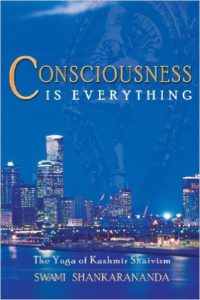
Excerpt from the book ‘Consciousness is Everything‘ by Swami Shankarananda. 

Conciousness-200x300This book is designed for seekers who are well-established in their practice. It is also for those who have a special interest in Kashmir Shaivism and are curious as to how the discipline would be treated from a yogic perspective.
I recognise that I have included a daunting amount of Sanskrit words and technical ideas. Had I not written Happy [Swamiji’s guide to meditation Happy For No Good Reason], I would feel guilty about this. On the other hand, I am sure that seekers in the two categories I have mentioned will have no trouble with the text.Now, what if a beginning meditator wandered in here by mistake? Well,he can’t leave without at least reading Chapter Five, You Are Your Awareness. The essence is there. Also, I would refer him to Happy, which has sizeable discussions of Kashmir Shaivism. If he is willing to work through this text, however, I am providing here a short, nontechnical overview of Shaivism. It is the heart of Shaivism as I see it: Shaivism is known as ‘the three’ because it discusses these three subjects:

The nature of the Absolute

The nature of the human being and contraction

The method by which contraction is overcome

Shaivism holds that pure awareness and not matter is the basic stuff of the universe. This can be compared to the situation in a dream, in which the awareness of the dreamer is the fundamental substratum of everything that appears in the dream. The one Consciousness that underlies the universe can also be called God. Here we are referring to God as the Absolute, beyond any specific form.

Consciousness Itself

For reasons known only to Him, God decides to create a universe and become many. By means of His Power, which can be personified as His feminine aspect, He creates the universe in His own being, Himself becoming the individual soul by a process of contraction. Though it appears in Consciousness, the created world is real. The universe is actually Consciousness vibrating at different frequencies, becoming more material and gross as it unfolds.

The human individual is nothing but God in a contracted form. When the individual looks at himself, he notices that he has the same qualities as the Absolute, though they are shrunken and vitiated. God has perfect will, perfect knowledge and perfect ability to do, while the human individual has all of these powers in limitation. They show up in him as three basic knots within his being.

The first knot is limitation of will. The human individual experiences it in his heart as a painful sense of separation, weakness and grief. This is the fundamental birth trauma in which God becomes the individual. The limitation of knowledge is experienced in the mind. The human mind experiences darkness and confusion and strains to understand the truth. The third knot is experienced in the navel area and is felt as a sense of frustration and lack of fulfilment.

Shaivism asks us to recognise our similarity with God and ultimately our oneness with Him. It minutely examines the human condition as a contraction that moves us from the divine status to that of a human being. It recognises a power of contraction and delusion that brings this about. The power is real but is actually an aspect of God. One of the ways it shows up is in language. The language that God uses in His true state expresses His ecstatic song of oneness, while human language tends to perpetuate separation and weakness.

Having looked at the human situation, Shaivism now turns to the solution, a methodology for overcoming the woes and limitations of the human being. Shaivism proposes a comprehensive inner technology designed to restore the human being to his inherent oneness with God. For this, he has to loosen the knots in his heart, mind and navel by means of three methods.

To heal the contraction in his navel, he tries to act well in all situations and come into harmony with the higher power. To heal the contraction in his mind, having discovered its cause in the misuse of language, he tries to bring his thinking into alignment with his highest good. To heal the existential angst in his heart, he tries to transcend thinking altogether and merge himself in the oneness of pure Consciousness.

Having profoundly practised these spiritual methods, the Shaivite seeker recognises the divinity within his own Self and also outside himself in the world and in other people. His main insight is that the subject, or Consciousness, is not separate from the object, or matter. In fact, he experiences directly that the object is contained within his subjectivity,that is, within Consciousness. He has now reached the culmination and the goal of the practice of Shaivism and he stands as a liberated being, fully free within himself, shining with divine wisdom and radiant with love.


Love your own Self

Love your own Self

‘Meditate on your own Self, worship your own Self, honour your own Self, love your own Self. God dwells within you as you,’ said an advertisement in the local morning paper. This was an unusually positive message for an American paper with ties to the racially conflicted city of Detroit, Michigan.

It was September 1974, a beautiful time of year in the Midwest. I was living in Ann Arbor with Danny, a young man who was to become my husband, and working at the University of Michigan Counselling Services. A few days later he came home from class and told me he had received an invitation from his psychology professor to meet a holy man from India, a Guru named Baba Muktananda, the writer of the benevolent message.

Baba’s message uplifted and puzzled me. I was stirred by the mysterious words ‘God dwells within you, as you’. They resonated with truth. But, to believe that God lived within me, as me, seemed an impossible attainment.

The vision inherent in that message was powerful and compassionate, two qualities I had not yet encountered. Later, as I became familiar with my inner world, I began to understand its significance. I would not know the true meaning of Baba’s words until I understood how I made life difficult for myself.

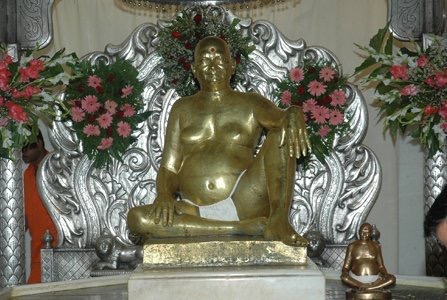
A few days later, intrigued and curious about the mystic East, Danny and I pulled up outside a grand old fraternity house. It was freshly painted white weatherboard with black shutters; something that would look more comfortable nestled at Cape Cod than in this small university town. It appeared normal except for the large black sign ‘Siddha Yoga Dham’ on the rooftop. As I entered, the smell of incense filled my nostrils. There was a subtle electricity in the atmosphere; everything was extraordinarily bright. My attention was drawn to a photograph of a naked man lying on his side, smiling mysteriously. He seemed odd, eccentric. I wondered who he was and what he represented but I was not dismayed. Even though the ambience was unfamiliar, I was completely at ease.

Baba was sitting on a small sofa, answering questions. The room was alive and still at the same time. His bright orange clothes blazed warmth in the fall chill. As I sat down I glanced up at him. Our eyes met and although no words were spoken, I felt welcomed. There was laughter as he told a story. He said that everyone had an inner Self and that happiness could be found within. As he spoke I felt a pull and my attention was drawn to my inner being. The room faded as I grew drowsy and the last thing I remember is my head falling forward. I came back to the room with a start to Danny poking me on the shoulder. Time had passed. I did not want to leave but we had to pick up a friend at the airport.

I felt a twinge of regret as I unsteadily stood to go. I wondered if I would see him again. I regretted that I was busy during the rest of the time he was visiting Ann Arbor. He was still answering questions, so without saying goodbye, we left. As we walked to the car I asked Danny how long we had been there. I was surprised to learn it was only half an hour. I felt like I had slept for eight hours, yet it was different. I was transported to a place deep within me, connected to the whole world, truly in touch with myself for the first time. As we drove away I said, ‘I don’t know what it is, but that man has something.’

(to be continued)