An old man lies rigid in the middle of the road. This country road only has one lane. Cars, trucks, motorcycles and bullock carts fight for space and swerve to avoid running over him. A group of bystanders watch from a distance. No one moves to help him. I wonder if he is drunk or sick or paralysed. We cannot stop the car and I pray someone helps him.
Welcome to India.
Here, every moment seems fraught with an unexpected happening. But the blessings of the Guru are already running like an electric current through my being.
Bhagawan’s Shakti is fierce and loving. He is unrelenting in his demand that we aspire to the highest state of Consciousness—to be detached, to be self-possessed, to be in the flow, to be free, to care more for God and less about our worldly desires and fears, to be loving and compassionate—this is the ultimate blessing of the Guru. If we get out of the way of his grace then the world is set right.
Gurudev Siddha Peeth
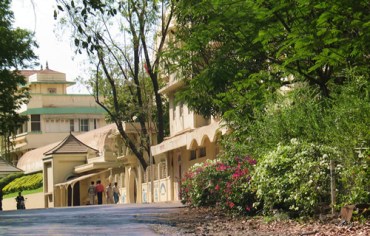
Gurudev Siddha Peeth is on the way to the village of Ganeshpuri. The walls stand like a fortress against alien entry. They remind me of a Tolkien book, Lord of the Rings. I reflect on my time there in the late 70s. ‘Leave your ego with your shoes!’ bellowed a sign over the shoe rack as I step through the lotus gates for the first time. The Shakti shuts down my mind and my heart fills with bliss. I was never the same.
In the mornings I scrub the outer courtyard to perfection. It is joyous to be on my knees polishing the marble. After three days I am moved into the publications department to type on an old Underwood. Not a particularly good typist I prefer the courtyard. I surrender to the Shakti’s will.
When I returned home to Ann Arbor after three months I felt as though I was being squeezed through a tiny tube. My personal karma weighed me down. I remember thinking, ‘this is what birth must feel like. Coming from pure Consciousness into the body, spirit to matter.’ The contraction was overwhelming. I could hardly breathe under its weight. It took a few months to return to normal.
Now, almost 40 years later, I feel grateful to have known and served Baba. I recall his great heart, his nectar love, his fiery nature, his overwhelming presence, power and magic. To be in Baba’s kingdom was to be transported to the Satya Yuga, a time of truth and peace and welcome. I do not long for the past and yet a part of me wishes the present was different.
I feel the Guru’s welcome as I pranam to Bhagawan. I go next door to the Shiva temple. As I walk down the stairs I am hit by a powerful force of Shakti and as I bow to the lingam I hear Baba’s voice, ‘I am here now.’
Gurubhakti, love of the guru, is palpable in Ganeshpuri. I take heart that the village is open to us even though we are in some way, interlopers. I can only glimpse the complexity of village life. There is a natural balance that is disturbed by our group’s presence. It is inevitable that when East meets West there is a clash. To be tentative here is to be wise. We bring prosperity, charity and caring and we receive love and Bhagawan’s grace. The villagers are not used to so much input from the West. Occasional Western visitors pass through but large groups of 90 to 100 like ours are rare. We are slowly becoming family.
To walk through the temple doors and glimpse Bhagawan as he presides over this domain is a joy. Even though his Shakti is powerful in Mt Eliza, here for me, he is more potent. To watch the devotees file in one by one gives me such pleasure. The newbies especially are looking at him in wonder. Their faces are radiant with light and awe. The mystical power emanating from Bhagawan can only be God’s grace. This place is magical.
Guruji has often said that his favorite service to Baba was to introduce new people to him. And now with humility and love he leads them to Bhagawan. I pray, ‘let these doors always be open.’
Guruji and I are ushered beyond the silver barriers into his samadhi. We are allowed to touch him, receive his blessings and bow. We perform the Arati and everyone chimes in. The priests are smiling and glad to see us. It is so good to be home.
Excerpt from Chapter 2, Happy For No Good Reason by Swami Shankarananda
magnaha svachittena pravishet
Meditation is achieved by diving into the
deeper levels of the mind. (Shiva Sutras III.21)
TAKING ADVANTAGE OF modern technology you can immediately begin to meditate. The value you receive from these teachings will depend, most of all, upon your commitment to a daily practice of meditation. I suggest you sit down and listen to the Chakra Meditation, the first two tracks, after reading this short chapter.
The first track is just under eight minutes long. I use this technique in all my meditation courses. It helps you become aware of inner tension. In this meditation you investigate the thoughts and feelings in four of the seven chakras: the navel, the heart, the throat and the brow. I ask questions like: “Is the feeling pleasant or unpleasant, tense or relaxed?” This gives you an awareness of the tensions and blocks you may be carrying and also puts you in touch with expanded and uplifting feelings.The second part is the Healing Meditation . Here relaxation and wellbeing are emphasized. You return to the four chakras with a view towards acceptance,love and peace. Follow my narration using its statements and images to release the tension. Experiment with each idea and image. At the end you can find the best feeling and focus on it for the rest of the meditation.
ESTABLISHING YOUR PRACTICE: WHERE AND WHEN
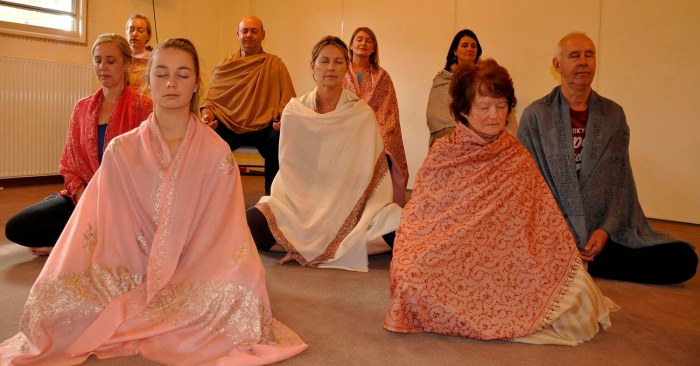
The traditional time for meditation is early morning. Your mind is calm,the phone is not ringing and the children are asleep. Another good time to meditate is at night before you go to bed or early evening just after you have come home from work. Experiment and see what works for you.A proper meditation posture helps the energy of meditation flow throughout the body. Zen meditation quite rightly describes two ways not to meditate. The first is called Kontin,the posture is too “mushy,” too loose—the chin falls, the back bends. The second, sanran , is the opposite. The meditator manifests too much rigidity and tension in the body. One is too easy-going and surrendered,the other too tight and self-willed.You can sit in a comfortable easy chair or on a cushion on the floor. Your posture should be relaxed and comfortable but also alert. It is best to sit with your back straight and hold your head erect but without tension. It is all right if your head falls forward or backward after you have been meditating for a while.Wear comfortable clothes. You may want to keep a blanket or a favourite sweater handy in case your temperature drops. You may feel cool one moment and warm the next.
Everyone can meditate. Sit on the floor or sit in a comfortable chair.
Hatha Yoga has become very popular in the West and is practised to prepare the body to sit for meditation. The postures increase flexibility,strengthen the spine and release tension. Hatha Yoga works on every aspect of the body, including the organs. It is physical culture for the 21st Century. Good health and suppleness are by-products. I suggest you find a good teacher in your area and learn the postures. It will help you meditate effectively.
Where possible set aside a room or a niche for meditation. When you meditate in the same place every day, the meditation energy builds. You can create an energy-filled space by placing pictures of great beings or symbols of higher Consciousness around the area—whatever objects or music you find conducive for entering meditation. You might want to burn some essential oils or incense. This creates a positive atmosphere.
I knew a woman whose husband was violently opposed to meditation. If her meditation paraphernalia was visible it caused turmoil in the house. She cleaned out her closet and created a meditation “cave”. She put her meditation pillow in there and had a tape of the mantra playing constantly. She would tell her family: “I am going to my cave to meditate.” She was, in every sense of the word, a closet meditator.
Meditation is the single most important discovery I have ever made.Without doubt it has transformed my experience of life. It gives me great joy to welcome you to the practice.
YOUR FIRST MEDITATION
Now is a good time to sit down and become familiar with the Chakra Meditation. Close your eyes, turn within and follow the instructions on the CD or do the written meditation in the appendix. Meditate to the first two tracks.
Chakra Meditation
KEY IDEAS OF CHAPTER TWO: YOUR FIRST MEDITATION
The traditional time for meditation is early morning.
Proper posture helps the energy flow.
Sit comfortably. Keep your back straight but relaxed. Do not become rigid.
Hatha Yoga helps prepare the body to sit for meditation.
You can create an energy-filled meditation space.
Meditating in the same place every day builds the energy.
Use your CD or your Chakra Meditation every day for at least half
an hour.
Even if you have the CD it is useful to read through the written form in the appendix one time.
Excerpt from Self-inquiry: Using your Awareness to unblock your life by Swami Shankarananda
AS A SPIRITUAL teacher, I meet many people. I hear sad stories. I’ve come to the conclusion that the task of being a human being is a difficult one.
When the soul takes on a body, it becomes confused. The physical plane is indeed hard to master. People don’t know how to conduct their relationships. They don’t know what to say and when to say it. They don’t know how to earn a living nor how to save their money. They don’t know how to deal with their desires and fears nor how to discipline the energies of their body.
When we are born, we are not given a how-to manual, and the advice we get from our family and culture may be remarkably wrongheaded. Nonetheless, there is an appropriate art of living. The great masters have called this art many things: living in the Tao, Zen, yoga, Tantra, the natural state (sahaja samadhi). These names given by different traditions refer to the same thing: a life lived from the centre outward, a life in contact with the Self. Because we are blocked in career and relationship, in the areas of health and wellbeing, we need a method to cut away the misinformation under which we struggle, and get to the truth. Self-inquiry is that method. Self-inquiry gives us a way to deconstruct the false constructions of the mind, and reveal the true Self.
Self-inquiry is the mother of all spiritual methods and all forms of meditation. It is direct, sleek and effective. It requires no religious belief, nor any dogma to practise it. It is very much in the modern spirit because, like science, it is a quest to discover what is. The need for inquiry becomes critical when we understand that we are broadcasting stations for our feelings. We live life passionately and we always speak and act out of one feeling or another. If we have a negative feeling, like tension, anger, fear or depression, we express that feeling through negative thoughts, negative actions and negative speech. We blame others. Our thoughts, words and deeds express our negativity.
This has a profound impact on our life. If we are broadcasting negativity, other people feel it. We don’t get the job we have interviewed for. People move away from us. They avoid our company. Even our pets run away. We may blame circumstances and other people, but the source is in the thoughts and feelings that we are broadcasting through our speech and our actions. As intelligent yogis, we become aware of our negativity, whether by direct instruction or the feedback we are getting from others. Instead of projecting the feeling, we take it inside through Self-inquiry and seek to purify it. We investigate the feeling, release it, relax it and take responsibility for it. After successful inquiry, our feeling is now positive. We radiate joy, love, peace and confidence, which translate into positive thoughts, positive actions and positive speech. Now we get the job we seek and people want to be around us. Our life is positively transformed by means of Self-inquiry.
(Try listening to the below meditation Speaking to your mind.)
Sri Ramana Maharshi
Sri Ramana Maharshi
The name most linked to Self-inquiry in the history of spirituality is that of the great 20th-century Indian sage, Sri Ramana Maharshi. Ramana said that all methods must necessarily end in inquiry. His reasoning was something like this: you meditate on an image of the deity or the Guru, or you contemplate a spiritual principle, or even look at a yantra (sacred diagram). In the end, the question will arise, ‘Who is it that is seeing, hearing or experiencing whatever you are meditating on?’ And with that question, inquiry begins. The attention moves from the object to the witnessing subject; from the periphery to the centre. Self-inquiry is an inner investigation that moves to the core of reality—ever more inward, more real, more true, more present, more vibrant, more central is its direction and thrust.
I met my Guru, Swami Muktananda (Baba), in Delhi early in 1971. There was a big tent on a sprawling lawn and hundreds of people were attending satsang, a spiritual gathering in the company of a great being. In the corner, a young man was sitting in meditation but he was also vibrating, hyperventilating and flopping about like a fish. I’d already heard that Swami Muktananda had a legendary power to awaken the kundalini energy, the inner divine power of seekers, and this caused kriyas, yogic movements, that were sometimes quite physical or even violent. This was the first one I’d ever seen and I looked at it with a sceptical eye. But it passed the test: I knew it was genuine. Some force other than his own will was moving in that young man. At the same time, an inner knowing arose in me: ‘That will not happen to me!’
I was correct in that while I had many spiritual experiences, I never did flop about like a fish. But shaktipat, awakening of the kundalini energy by the Guru, can manifest in a wide variety of ways. Because of my scepticism, when the energy started coursing through my body forcefully, my first thought was that I might have malaria! Finally I noticed that my ‘malaria’ was strangely responsive to the evening Arati program. I realised I was experiencing an awakening.
In my case, the most significant effect of shaktipat was that it drove my mind inward and gave birth to the process of inquiry that has become the Shiva Process. My mind had been exceedingly external; only divine grace could reorient it inwardly. Feeling frustrated with my efforts to know the Self, I asked Baba for advice. He told me that rather than straining to know the Self conceived of as far away, I should know that the Self is always complete and perfect within me. He said I should contemplate ‘I am the Self. I am Shiva’. By Shiva, he was not referring to the Hindu deity of that name, but to universal Consciousness, the substance of the Self. His answer transformed my sadhana by 180 degrees. I no longer felt I was striving for some attainment, but rather that the attainment was already present and I had to rediscover it.
According to one yogi, there are two significant obstructions to knowing the Self. One is ignorance of its existence and of the possibility of making contact with it. The other is a tight, cramped state of inner tension. Baba’s answer had solved the first, though the latter remained a problem.
On another occasion, I was meditating in the company of my teacher. Feeling on that day the contraction of my being, and frustrated by how far away the goal seemed, I strained to go deeper and have a more profound experience. I felt blocked and discouraged. Suddenly, the understanding arose in me, ‘You may not be having the meditation you want, but you can always have the meditation you’re having’. With it came an intuitive grasp of a completely different spiritual orientation. I would no longer seek something I felt I needed or wanted, but I would now investigate what actually existed. Combining this with Baba’s instruction that I should contemplate ‘I am the Self’, I had the beginnings of a complete method. Following it, I focus on my inner world, arming myself with his instruction that the Self is already here, already present, though perhaps hidden. I decide to investigate my experience in the very moment. Exploring inwardly, I discover a rich variety of phenomena: movements of energy, subtle feelings and sensations.
With my inner eye, I see a number of lights. Most interestingly, I discover blocks and areas of tension in my subtle world. These attract my attention. I can see directly that they affect my wellbeing and my emotional state. The energy of my inner world does not flow properly and harmoniously as long as these tensions remain. I intuit that these blocks, which are more subtle than physical, can eventually manifest as disease. Acknowledging that these tensions have a profound effect on me as well as on my spiritual state, I feel I’ve come face to face with my spiritual dilemma as it shows up in the moment. I begin to investigate these perceived blocks. What are they made of? What causes them? I try to get as close to them experientially as I can. I inquire into them and they yield information. My inner voice tells me, ‘This is anger. This is fear’. I inquire further. A knowing arises that these tensions are connected to a circumstance that happened today, or a week ago, or even years before. I am starting to unravel the mystery of my inner being.
Sometimes a solution to a block arises in my awareness spontaneously, and when that happens, the block dissolves and I feel a release of tension. My inner being is more harmoniously poised. I leave this meditation in a far more uplifted state than I began it.
I had hit on a method that seemed a universal way of dealing with spiritual obstacles. Where Ramana’s inquiry focused only on Self-knowledge,the inquiry I was doing was applicable to all areas of life. I discovered that the problems I encountered with other people, issues of work in the ashram, doubts that arose in my sadhana, all showed up within me as tensions and blocks. I could work within myself to release these blocks by finding intuitive means. Having worked on them within, I noticed that obstacles were simultaneously removed from my outer life. My inquiry took wings in the presence of my Guru, and I felt certain that his spiritual energy, his Shakti, brought my inquiry to a boil.
The philosophy of Kashmir Shaivism says that this whole universe is an unfoldment of Consciousness. At the very interior of the universe is divinity, pure light, pure energy and pure love. As Consciousness unfolds externally, things become more gross and material. When we investigate anything, we go in the opposite direction—from the outer to the inner, from the husk to the kernel, from the external to the essence. In a world of Consciousness, everything is subject to inquiry. When we have a conversation, there are the words that we speak and their meaning, and then deeper down, a more real conversation occurs at the emotional level. The universe is a detective story and becomes, as we move from the periphery to the centre, always more real.
 nstructions of the mind, and reveal the true Self.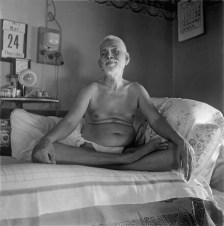
 The Voice of the Self